


Page 535 - The Book of Caterpillars: A Life-Size Guide to Six Hundred Species From Around the World
P. 535
MOTH CATERPILLARS

                      FAMILY  Notodontidae
                  DISTRIBUTION  North America
                     HABITAT  Deciduous woodlands and forests, parks, and gardens
                  HOST PLANTS  Various trees and shrubs, including Alder (Alnus glutinosa),
                           birch (Betula spp.), hawthorn (Crataegus spp.), poplar
                           (Populus spp.), and willow (Salix spp.)

                      NOTE  Cleverly camou aged caterpillar that squirts acid if disturbed
             CONSERVATION STATUS  Not evaluated


                                                                                   ADULT WINGSPAN


                                                                                    ⁄  –1⅜ in (24–35 mm)
                                                                                  CATERPILLAR LENGTH
                                                                                    1 ⁄   in (30 mm)
            SCHIZURA UNICORNIS
            UNICORN CATERPILLAR                                                                  533

            (J. E. SMITH, 1797)


            Female Unicorn moths lay small, round eggs on the underside
            of leaves of the host plant. They hatch into odd-looking
            caterpillars that are active from May to October. The larvae
            then drop to the ground, where they spin a protective cocoon
            in the leaf litter. This species overwinters as a caterpillar and
            pupates within its cocoon in spring. The adult moths are on the
            wing from February to September in the more southerly zones
            of their range and May to August in the north. There is a single
            generation each year.


            The Unicorn gets its name from the appearance of the caterpillar.

            It has a large horn on the  rst abdominal segment, and is also
            equipped with a cervical gland from which it squirts formic acid,
            if disturbed. The horn, together with the disruptive coloration
            created by the green band across the thorax, provide excellent


            camou age. The adult moth also relies on camou age, wrapping
            its wings around its body to form a tube that looks like a piece
            of broken twig.


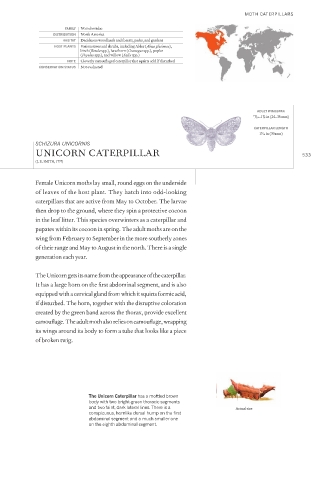
                             The Unicorn Caterpillar has a mottled brown
                             body with two bright-green thoracic segments
                             and two faint, dark lateral lines. There is a   Actual size
                             conspicuous, hornlike dorsal hump on the   rst
                             abdominal segment and a much smaller one
                             on the eighth abdominal segment.

