


Page 536 - The Book of Caterpillars: A Life-Size Guide to Six Hundred Species From Around the World
P. 536
MOTH CATERPILLARS

                                                     FAMILY  Notodontidae
                                                 DISTRIBUTION  Across central and southern Europe, parts of northern Europe
                                                          into southern Russia, Turkey, Iran, and Iraq
                                                    HABITAT  Oak woodlands, grasslands, and scrub areas near oak
                                                  HOST PLANTS  Oak (Quercus spp.)
                                                      NOTE  Twiglike caterpillar that feeds on oak leaves
                                             CONSERVATION STATUS  Not evaluated, but endangered in parts of its range


            ADULT WINGSPAN


           1⅜–1 ⁄   in (35–40 mm)
           CATERPILLAR LENGTH
             2 in (50 mm)
                                                                           SPATALIA ARGENTINA
                                                             ARGENTINE MOTH
    534
                                                                          (DENIS & SCHIFFERMÜLLER, 1775)


                                            Argentine Moth caterpillars hatch from eggs laid on the older
                                            leaves of oak trees. Typically, the larvae start feeding at the tip
                                            of the leaf blade and work down either side of the midrib. Their

                                            twiglike appearance provides excellent camou age among the
                                            foliage. The caterpillars move to the ground to pupate, spinning
                                            a loose cocoon, and the dark brown pupa overwinters, with the
                                            adult moths eclosing in late spring.


                                            The night- ying Argentine Moth, which, confusingly, is not

                                            found anywhere in South America, is also known as the Silver
                                            Stain-toothed Spinner. The moths are on the wing from April to
                                            August, with two generations, although there may only be one in
                                            the north of the range. Spatalia argentina is under threat from the
                                            loss of oak woodlands, especially those of an open structure with
                                            young growth. Also, the moth is killed when foresters spray trees
                                            to destroy defoliating moths such as the Gypsy Moth (Lymantria
                                            dispar), which also feeds on oak.


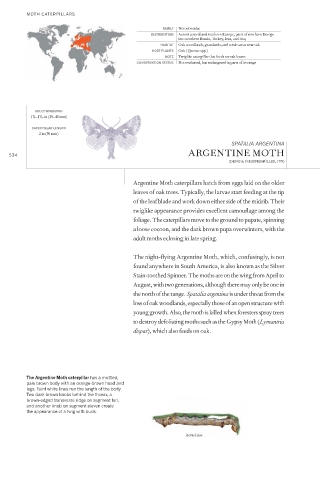
         The Argentine Moth caterpillar has a mottled,
         pale brown body with an orange-brown head and
         legs. Faint white lines run the length of the body.
         Two dark brown knobs behind the thorax, a
         brown-edged transverse ridge on segment ten,
         and another knob on segment eleven create
         the appearance of a twig with buds.


                                                            Actual size

