


Page 538 - The Book of Caterpillars: A Life-Size Guide to Six Hundred Species From Around the World
P. 538
MOTH CATERPILLARS

                                                     FAMILY  Notodontidae
                                                 DISTRIBUTION  Europe into Asia
                                                    HABITAT  Woodlands, parks, and gardens
                                                  HOST PLANTS  Mostly oak (Quercus spp.); also others, including beech
                                                          (Fagus spp.), birch (Betula spp.), Hazel (Corylus avellana),
                                                          and sweet chestnut (Castanea spp.)
                                                      NOTE  Caterpillar that has thousands of detachable hairs with
                                                          a hazardous irritant
                                             CONSERVATION STATUS  Not evaluated


            ADULT WINGSPAN


           1–1⅜ in (25–35 mm)
           CATERPILLAR LENGTH
             1 ⁄   in (30 mm)
                                                                  THAUMETOPOEA PROCESSIONEA
                                                        OAK PROCESSIONARY
    536
                                                                                   (LINNAEUS, 1758)


                                            Female Oak Processionary moths lay their eggs in rows on twigs
                                            and branches. The eggs overwinter, and the caterpillars emerge
                                            in April. The larvae are gregarious and spin communal silk nests
                                            under branches and on trunks, leaving trails of white silk. They
                                            also defoliate much of their host tree, making it more vulnerable
                                            to disease. As they develop through each instar, the caterpillars
                                            molt and pupate within the nest, giving it a brown appearance.
                                            The adult moths are on the wing from May to September.


                                            These caterpillars are named after their habit of walking in nose-
                                            to-tail processions along branches and on the ground. Their
                                            hairs contain thaumetopoein, an intensely irritating compound,
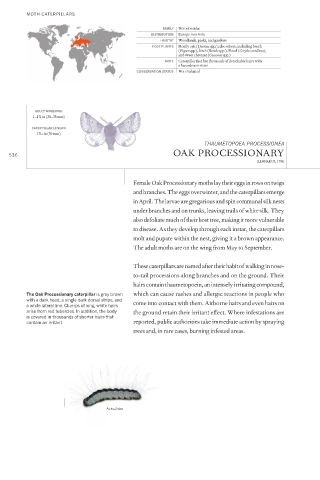
         The Oak Processionary caterpillar is gray brown   which can cause rashes and allergic reactions in people who
         with a dark head, a single dark dorsal stripe, and   come into contact with them. Airborne hairs and even hairs on
         a white lateral line. Clumps of long, white hairs

         arise from red tubercles. In addition, the body   the ground retain their irritant e ect. Where infestations are
         is covered in thousands of shorter hairs that
         contain an irritant.               reported, public authorities take immediate action by spraying
                                            trees and, in rare cases, burning infested areas.


                                   Actual size

