


Page 537 - The Book of Caterpillars: A Life-Size Guide to Six Hundred Species From Around the World
P. 537
MOTH CATERPILLARS

                      FAMILY  Notodontidae
                  DISTRIBUTION  Europe, east across Asia (excluding the south) to Japan
                     HABITAT  Woodlands, especially beech (Fagus spp.), scrub, hedgerows,
                           and orchards
                  HOST PLANTS  Various trees and shrubs, including apple (Malus spp.), beech
                           (Fagus spp.), birch (Betula spp.), Hazel (Corylus avellana),
                           lime (Tilia spp.), and willow (Salix spp.)
                      NOTE  Caterpillar whose bizarre outline is the perfect disguise
             CONSERVATION STATUS  Not evaluated


                                                                                   ADULT WINGSPAN
                                                                                  2–2¾ in (50–70 mm)
                                                                                  CATERPILLAR LENGTH
                                                                                    2¾ in (70 mm)
            STAUROPUS FAGI
            LOBSTER MOTH                                                                         535

            (LINNAEUS, 1758)


            Lobster Moth caterpillars hatch from small, round eggs laid
            singly on leaves. The young larvae, which in their initial instar
            feed only on their eggshell, are mimics of ants or small spiders,
            and, if disturbed, they wiggle like an injured ant. They are also
            aggressive and will attack any approaching small insect. With
            each molt, the caterpillars take on a more extreme appearance,
            with long legs and an enlarged abdomen. The mature larvae
            move to the ground, where they pupate in a cocoon in the
            leaf litter and overwinter. The adult moths are on the wing in
            May and June.


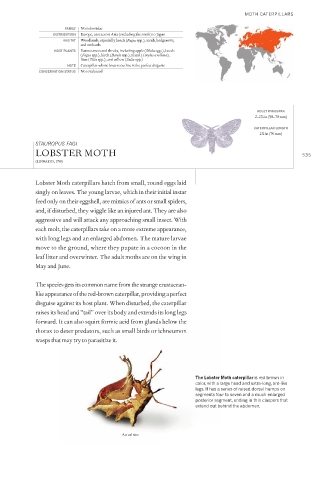
            The species gets its common name from the strange crustacean-
            like appearance of the red-brown caterpillar, providing a perfect
            disguise against its host plant. When disturbed, the caterpillar
            raises its head and “tail” over its body and extends its long legs
            forward. It can also squirt formic acid from glands below the
            thorax to deter predators, such as small birds or ichneumon
            wasps that may try to parasitize it.


                                                               The Lobster Moth caterpillar is red brown in
                                                               color, with a large head and extra-long, ant-like
                                                               legs. It has a series of raised dorsal humps on
                                                               segments four to seven and a much enlarged
                                                               posterior segment, ending in thin claspers that
                                                               extend out behind the abdomen.


                                        Actual size

