


Page 539 - The Book of Caterpillars: A Life-Size Guide to Six Hundred Species From Around the World
P. 539
MOTH CATERPILLARS

                      FAMILY  Erebidae
                    TRIBUTION
                  DISTRIBUTION  The Andes of Colombia and Ecuador
                  DIS
                  DISTRIBUTION
                     HABITAT
                        A
                     HABITAT T  Humid montane forests and forest borders
                     HABIT
                  HOST PLANTS S  Erato polymnioides and Miconia spp.
                    T PLANT
                  HOS
                  HOST PLANTS

                      NO
                      NOTE
                      NOTE  Caterpillar with setae that break o  and cause skin irritation
                        TE
                       TUS
                      T
                   TION S
                       A
                  A
             CONSERVATION STATUS  Not evaluated, but not considered threatened
             CONSERV
             CONSERVATION STATUS
                                                                                   ADULT WINGSPAN
                                                                                  2 ⁄  –3 ⁄   in (65–77 mm)
                                                                                  CATERPILLAR LENGTH
                                                                                  2⅜–2¾ in (60–70 mm)
            AMASTUS AMBROSIA
            AMASTUS AMBROSIA                                                                     537
            (DRUCE, 1890)
            The robust Amastus ambrosia caterpillar is found as a solitary
            individual on its host plant, and it is not known how many eggs
            the adult lays in a single batch. The caterpillar is covered in
            brown, hairlike setae and, prior to pupation, creates a cocoon
            of these hairs around its pupa, presumably providing good
            protection from predators. At least one bird, the Fawn-breasted
            Tanager (Pipraeidea melanonota), however, has been observed
            to consume the spiky larvae. The caterpillar’s bright crimson
            spiracles on an otherwise dark-colored body might be a form
            of warning coloration, although they are mostly obscured from
            view by setae.


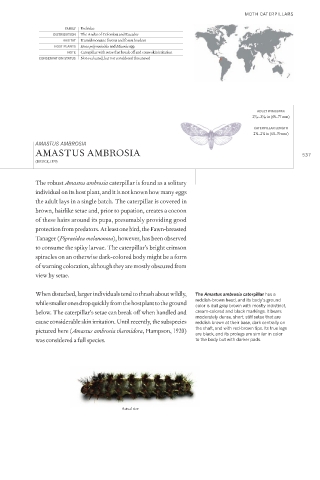
            When disturbed, larger individuals tend to thrash about wildly,   The Amastus ambrosia caterpillar has a
            while smaller ones drop quickly from the host plant to the ground   reddish-brown head, and its body’s ground
                                                               color is dull gray brown with mostly indistinct,
            below. The caterpillar’s setae can break o  when handled and   cream-colored and black markings. It bears

            cause considerable skin irritation. Until recently, the subspecies   moderately dense, short, sti   setae that are
                                                               reddish brown at their base, dark centrally on
            pictured here (Amastus ambrosia thermidora, Hampson, 1920)   the shaft, and with red-brown tips. Its true legs
                                                               are black, and its prolegs are similar in color
            was considered a full species.                     to the body but with darker pads.


                                        Actual size

