


Page 540 - The Book of Caterpillars: A Life-Size Guide to Six Hundred Species From Around the World
P. 540
MOTH CATERPILLARS

                                                     FAMILY  Erebidae
                                                 DISTRIBUTION  Around the Mediterranean, east to central Asia and areas
                                                          of northwest China
                                                    HABITAT  Dry scrub and grasslands
                                                  HOST PLANTS  Various members of Fabaceae, especially Genista spp.
                                                          and Spartium spp.
                                                      NOTE  Caterpillar whose bright colors indicate it is distasteful
                                             CONSERVATION STATUS  Not evaluated, but common


            ADULT WINGSPAN
           2  ⁄  –3¼ in (74–82 mm)
           CATERPILLAR LENGTH
             1 ⁄   in (40 mm)
                                                                          APOPESTES SPECTRUM
                                                      APOPESTES SPECTRUM
    538
                                                                                     (ESPER, 1787)


                                            Apopestes spectrum caterpillars hatch from eggs laid on various
                                            members of the Fabaceae plant family, in particular Spanish
                                            Broom (Spartium junceum). Their elaborate colors make the
                                            caterpillars conspicuous and are a clear warning to would-be
                                            predators to stay away. The larvae are active from late spring
                                            to midsummer, when they pupate. The moths eclose in July
                                            and then go into hibernation, overwintering and emerging the
                                            following spring as temperatures rise. There is one generation
                                            a year, with the moths on the wing in spring.


                                            This species was previously classi ed as Noctua spectrum. It has

                                            been the subject of extensive studies in China, where increasing
                                            numbers of the larvae and adults are resulting in the damage of
                                            nationally important wall murals in caves in the northwest of the
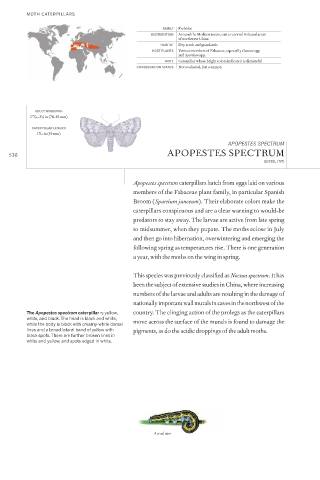
          The Apopestes spectrum caterpillar is yellow,   country. The clinging action of the prolegs as the caterpillars
          white, and black. The head is black and white,   move across the surface of the murals is found to damage the
          while the body is black with creamy-white dorsal
          lines and a broad lateral band of yellow with   pigments, as do the acidic droppings of the adult moths.
          black spots. There are further broken lines in
          white and yellow, and spots edged in white.


                                                  Actual size

