


Page 541 - The Book of Caterpillars: A Life-Size Guide to Six Hundred Species From Around the World
P. 541
MOTH CATERPILLARS

                      FAMILY  Erebidae
                  DISTRIBUTION  Southern Canada, United States (from New York west to
                           Washington State, Oregon, and California); also Europe
                           and across Asia, excluding the far north and south
                     HABITAT  Gardens, parks, river valleys, and meadows
                  HOST PLANTS  Wide variety of herbaceous plants, including nettle (Urtica spp.),
                           Bracken (Pteridium aquilinum), dock (Rumex spp.), blackberry
                           (Rubus spp.), and honeysuckle (Lonicera spp.)
                      NOTE  Spectacularly hirsute caterpillar popularly known as a
                           “woolly bear”
             CONSERVATION STATUS  Not evaluated, but declining in many countries


                                                                                   ADULT WINGSPAN
                                                                                  1¾–2 ⁄   in (45–65 mm)
                                                                                  CATERPILLAR LENGTH
                                                                                  2⅛–2⅜ in (55–60 mm)
            ARCTIA CAJA
            GARDEN TIGER MOTH                                                                    539

            (LINNAEUS, 1758)


            Garden Tiger Moth caterpillars hatch from bluish-yellow eggs
            laid by the female moth in batches of up to 50 some 10 days earlier
            on the underside of host plant leaves during July and August.
            The caterpillars immediately disperse to live solitary lives.
            After a couple of instars, the partially grown larvae hibernate
            and then resume feeding and growth in spring. Development is
            usually completed by the end of May, when prepupal caterpillars
            are often seen wandering, on the look out for pupation sites.
            Pupation takes place in a sparsely spun cocoon made of silk and
            caterpillar hairs.


            The adult moth emerges in July and is spectacularly colored
            in brown, white, red, and blue, its striking appearance advertising
            distastefulness to predators. Despite being covered in long
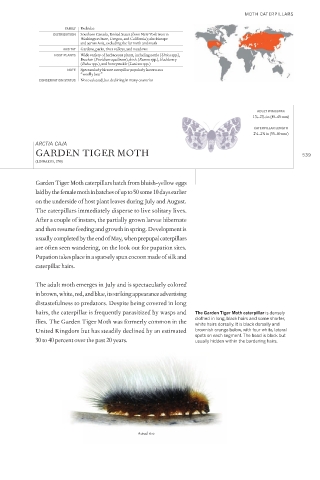
            hairs, the caterpillar is frequently parasitized by wasps and   The Garden Tiger Moth caterpillar is densely
            flies. The Garden Tiger Moth was formerly common in the   clothed in long, black hairs and some shorter,
                                                               white hairs dorsally. It is black dorsally and
            United Kingdom but has steadily declined by an estimated   brownish orange below, with four white, lateral
            30 to 40 percent over the past 20 years.           spots on each segment. The head is black but
                                                               usually hidden within the bordering hairs.


                                             Actual size

