


Page 542 - The Book of Caterpillars: A Life-Size Guide to Six Hundred Species From Around the World
P. 542
MOTH CATERPILLARS

                                                     FAMILY  Erebidae
                                                 DISTRIBUTION  Europe and across northern and central Asia to Japan
                                                    HABITAT  Deciduous and mixed forests
                                                  HOST PLANTS  Various trees, including beech (Fagus spp.) and birch (Betula spp.)
                                                      NOTE  Caterpillar that uses sudden movement and falling to
                                                          avoid predation
                                             CONSERVATION STATUS  Not evaluated


            ADULT WINGSPAN

           1⅜–1¾ in (35–45 mm)

           CATERPILLAR LENGTH
             2 in (50 mm)
                                                                          ARCTORNIS L-NIGRUM
                                                                              BLACK V
    540
                                                                                    (MÜLLER, 1764)


                                            Black V caterpillars hatch from eggs laid by the female moth
                                            in small groups on the surface of leaves of the host trees, and
                                            feed there. When not feeding, the larvae rest on the leaves
                                            and, if disturbed, they flick to one side and sometimes fall
                                            deliberately in an e ort to avoid predation. The second or third

                                            instar caterpillars move to the ground, where they spend the
                                            winter in the leaf litter, sometimes crawling into rolled-up leaves.


                                            The larvae emerge in spring and resume feeding to complete
                                            their growth.They then pupate in a cocoon, which they spin
                                            among leaves. There is usually one generation, but occasionally
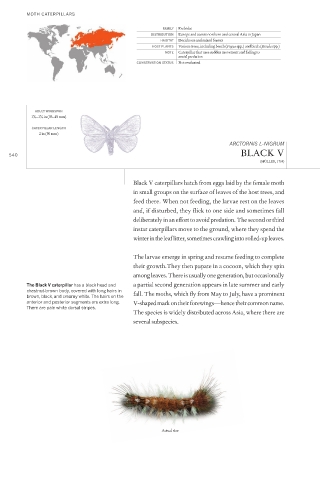
          The Black V caterpillar has a black head and   a partial second generation appears in late summer and early
          chestnut-brown body, covered with long hairs in   fall. The moths, which  y from May to July, have a prominent

          brown, black, and creamy white. The hairs on the
          anterior and posterior segments are extra long.   V-shaped mark on their forewings—hence their common name.
          There are pale white dorsal stripes.
                                            The species is widely distributed across Asia, where there are
                                            several subspecies.


                                                     Actual size

