


Page 59 - The Book of Caterpillars: A Life-Size Guide to Six Hundred Species From Around the World
P. 59
BUTTERFLY CATERPILLARS

                      FAMILY  Papilionidae
                  DISTRIBUTION  Western North America, from British Columbia to Guatemala
                     HABITAT  Canyon bottoms, roadsides, riparian areas, shrub-steppe,
                           parks, and gardens
                  HOST PLANTS  Cherry and plum (Prunus spp.), ash (Fraxinus spp.),
                           and serviceberry (Amelanchier spp.)
                      NOTE  Rarely seen caterpillar that is among the largest in North America
             CONSERVATION STATUS  Not evaluated, but common within its range


                                                                                   ADULT WINGSPAN
                                                                                  4⅝–5 in (120–130 mm)
                                                                                  CATERPILLAR LENGTH
            PAPILIO MULTICAUDATA                                                  2–2⅜ in (50–60 mm)
            TWO-TAILED TIGER
            SWALLOWTAIL                                                                           57

            W. F. KIRBY, 1884


            The Two-tailed Tiger Swallowtail caterpillar hatches from large
            eggs laid singly on the upper side of host plant leaves. The first

            instar consumes the eggshell before feeding on terminal leaves.
            Second instars spin a thin silk mat on the upper side of a leaf to
            which they return when not feeding. Older caterpillars produce
            similar mats, curving them into an upwardly convex shape; such
            “nest” leaves are not eaten. Later instars eat large gaps in leaves,
            or entire leaves, and sometimes rest on the underside of a leaf.


            Camouflage protects the caterpillars, as the defensive chemicals

            they emit—mainly from the orange, forked osmeterium—also
            protect them. Development is rapid, taking about 33 days
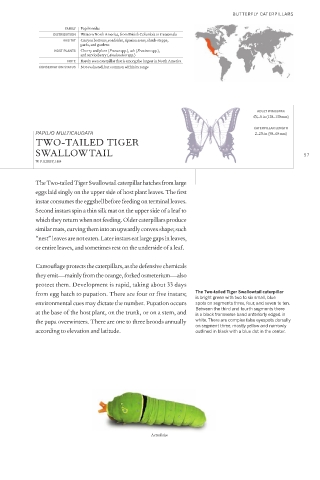
            from egg hatch to pupation. There are four or five instars;   The Two-tailed Tiger Swallowtail caterpillar
                                                               is bright green with two to six small, blue
            environmental cues may dictate the number. Pupation occurs   spots on segments three, four, and seven to ten.
            at the base of the host plant, on the trunk, or on a stem, and   Between the third and fourth segments there
                                                               is a black transverse band anteriorly edged in
            the pupa overwinters. There are one to three broods annually   white. There are complex false eyespots dorsally
            according to elevation and latitude.               on segment three, mostly yellow and narrowly
                                                               outlined in black with a blue dot in the center.


                                                 Actual size

