


Page 560 - The Book of Caterpillars: A Life-Size Guide to Six Hundred Species From Around the World
P. 560
MOTH CATERPILLARS

                                                     FAMILY  Erebidae
                                                 DISTRIBUTION  North America, from southern and southeastern Canada
                                                          to Florida, and west to Texas
                                                    HABITAT  Woodlands and forests
                                                  HOST PLANTS  Many woody shrubs and trees, including alder (Alnus spp.),
                                                          ash (Fraxinus spp.), birch (Betula spp.), elm (Ulmus spp.),
                                                          oak (Quercus spp.), and willow (Salix spp.)
                                                      NOTE  Conspicuous, hirsute caterpillar
                                             CONSERVATION STATUS  Not evaluated, but usually common


            ADULT WINGSPAN
           1 ⁄  –1¾ in (40–45 mm)
           CATERPILLAR LENGTH


             1⅜ in (35 mm)
                                                                        HALYSIDOTA TESSELLARIS
                                                  BANDED TUSSOCK MOTH
    558
                                                                                   (J. E. SMITH, 1797)


                                            Banded Tussock Moth caterpillars hatch from eggs laid in
                                            masses on the underside of host plant leaves. There are two
                                            generations each summer, and although not gregarious the
                                            larvae are conspicuous, preferring to rest openly on the upper
                                            side of leaves. This suggests they are not palatable to predators,
                                            either because of their tufted bodies or the chemical defenses
                                            they have acquired from host plants. Pupation occurs in a
                                            gray, silken cocoon laced with many of the caterpillar’s hairs.
                                            The pupae overwinter.


                                            As with many moth species, the caterpillars of the Banded
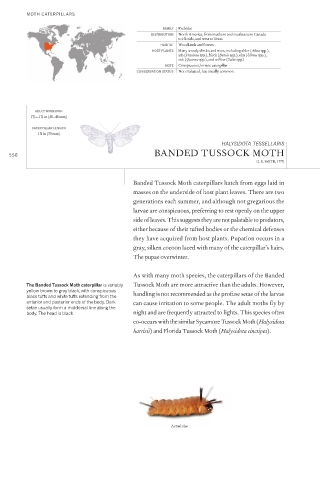
         The Banded Tussock Moth caterpillar is variably   Tussock Moth are more attractive than the adults. However,
         yellow brown to gray black, with conspicuous   handling is not recommended as the profuse setae of the larvae
         black tufts and white tufts extending from the
         anterior and posterior ends of the body. Dark   can cause irritation to some people. The adult moths fly by
         setae usually form a middorsal line along the
         body. The head is black.           night and are frequently attracted to lights. This species often
                                            co-occurs with the similar Sycamore Tussock Moth (Halysidota
                                            harrisii) and Florida Tussock Moth (Halysidota cinctipes).


                                                        Actual size

