


Page 555 - The Book of Caterpillars: A Life-Size Guide to Six Hundred Species From Around the World
P. 555
MOTH CATERPILLARS

                      FAMILY  Erebidae
                  DISTRIBUTION  The Andes of Colombia, south to Bolivia
                     HABITAT  Humid cloud forest interiors, especially along streams
                  HOST PLANTS  Many, including Sche   era dielssi, Oreopanax spp., Alloplectus
                           tetragonoides, Chusquea scandens, Dendrophorbium spp., and
                           Critoniopsis occidentalis
                      NOTE  Caterpillar that twitches its body spasmodically when disturbed
             CONSERVATION STATUS  Not evaluated, but not considered threatened


                                                                                   ADULT WINGSPAN
                                                                                 2⅝–2  ⁄   in (66–74 mm)
                                                                                  CATERPILLAR LENGTH
                                                                                  2⅜–2¾ in (60–70 mm)
            DYSSCHEMA PALMERI
            DYSSCHEMA PALMERI                                                                    553

            (DRUCE, 1910)


            Despite the fairly bright coloration of Dysschema palmeri
            caterpillars, they are infrequently encountered. The larvae
            feed solitarily, usually resting on the lower side of their host
            plant leaves, well out of sight from potential predators. When
            disturbed, they spasmodically twitch their head and rear
            sections, waving their long setae about over their body. So far
            as is known, the setae do not cause any sort of skin irritation.


            The adults of Dysschema palmeri resemble, and probably
            mimic, several of the larger species of clear-winged butter ies

            (Ithomiinae) within their range. They do not generally  y about

            during the day, instead resting below leaves with their wings
            folded back over their bodies in a roughly triangular shape,
            taking flight only when disturbed. It is not clear when this
            species’ eggs are laid, but possibly around dusk and dawn, when
            visibility is poor and the adults’ resemblance to toxic butter ies

            may still be an advantage.


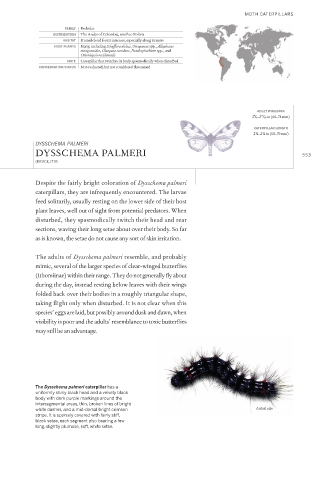
            The Dysschema palmeri caterpillar has a
            uniformly shiny black head and a velvety black
            body with dark purple markings around the
            intersegmental areas, thin, broken lines of bright
            white dashes, and a mid-dorsal bright crimson                          Actual size
            stripe. It is sparsely covered with fairly sti  ,
            black setae, each segment also bearing a few
            long, slightly plumose, soft, white setae.

