


Page 557 - The Book of Caterpillars: A Life-Size Guide to Six Hundred Species From Around the World
P. 557
MOTH CATERPILLARS

                      FAMILY  Erebidae
                  DISTRIBUTION  Across Europe into Russia,the Middle East as far as
                           Turkmenistan and Iran
                     HABITAT  Evergreen riparian forests, scrub, hedgerows, wastelands,
                           parks, and gardens
                  HOST PLANTS  Various, including borage (Borago spp.), dandelion
                           (Taraxacum spp.), Hemp (Cannabis sativa), agrimony
                           (Eupatorium spp.), and nettle (Urtica spp.)
                      NOTE  Hairy caterpillar that feeds on a range of food plants
             CONSERVATION STATUS  Not evaluated, but a protected species in the European Union


                                                                                   ADULT WINGSPAN
                                                                                  2 ⁄  –2 ⁄   in (52–65 mm)
                                                                                  CATERPILLAR LENGTH
                                                                                  1 ⁄  –2 in (40–50 mm)
            EUPLAGIA QUADRIPUNCTARIA
            JERSEY TIGER                                                                         555

            (PODA, 1761)


            The female Jersey Tiger moth lays her smooth, round eggs
            on the underside of leaves. When the young caterpillars hatch,
            they overwinter on their host plant and become active again
            in spring. The mature larvae crawl to the ground to pupate in
            a cocoon among the leaf litter, and the resulting pupae are
            reddish brown in color.

            The Jersey Tiger, as strikingly hued and patterned as its big
            cat namesake, flies during the day and night. The moths are
            on the wing from July to September, and there is a single

            generation. A migratory species, Euplagia quadripunctaria  ies
            long distances during the summer months and, due to warming
            conditions, is expanding its range north. The subspecies
            E. quadripunctaria rhodensensis can be found in large numbers
            in the Valley of Butterflies on the Greek island of Rhodes.
            Here, encouraged by a perfect microclimate, clouds of brightly
            colored moths take to the air in a spectacular display.

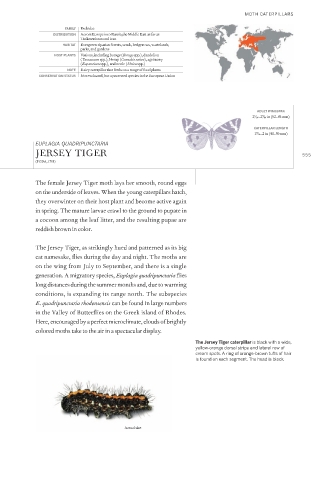
                                                               The Jersey Tiger caterpillar is black with a wide,
                                                               yellow-orange dorsal stripe and lateral row of
                                                               cream spots. A ring of orange-brown tufts of hair
                                                               is found on each segment. The head is black.


                                         Actual size

