


Page 561 - The Book of Caterpillars: A Life-Size Guide to Six Hundred Species From Around the World
P. 561
MOTH CATERPILLARS

                      FAMILY  Erebidae
                  DISTRIBUTION  Northeastern Ecuador to southeastern Peru
                     HABITAT  Forest and montane stream edges

                  HOST PLANTS  Barnadesia parvi ora, Adenostemma harlingii, Browallia speciosa,
                           and Solanum spp.
                      NOTE  Caterpillar with urticating hairs that can cause an itchy rash
             CONSERVATION STATUS  Not evaluated, but not considered threatened, although
                           not common


                                                                                   ADULT WINGSPAN
                                                                                  1½–1¾ in (38–44 mm)
                                                                                  CATERPILLAR LENGTH
                                                                                  2⅛–2¾ in (55–70 mm)
            HYPERCOMPE OBSCURA
            HYPERCOMPE OBSCURA                                                                   559

            (SCHAUS, 1901)


            Hypercompe obscura caterpillars are solitary feeders and,
            although they live on a wide variety of host plants, not common.
            The larvae can be found on almost any portion of the host plant,
            but they frequently rest along the midvein on the underside of
            the leaf. When disturbed, they tend to drop down from the plant

            and curl up into a ball,  ourishing their long, urticating setae.
            When at rest, these caterpillars are positioned with their tufts
            of setae held in close proximity, giving them the appearance of
            being completely covered in hairs. When feeding or moving,
            however, they expose the bare intersegmental areas, presumably
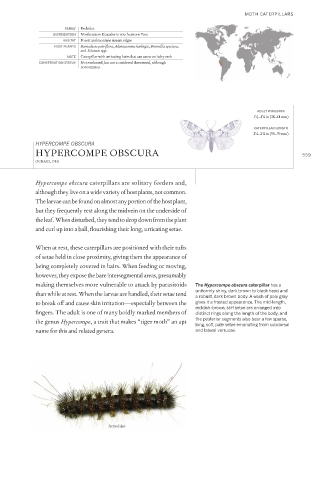
            making themselves more vulnerable to attack by parasitoids   The Hypercompe obscura caterpillar has a
            than while at rest. When the larvae are handled, their setae tend   uniformly shiny, dark brown to black head and
                                                               a robust, dark brown body. A wash of pale gray

            to break o  and cause skin irritation—especially between the   gives it a frosted appearance. The mid-length,

             ngers. The adult is one of many boldly marked members of   reddish-brown, sti   setae are arranged into
                                                               distinct rings along the length of the body, and
            the genus Hypercompe, a trait that makes “tiger moth” an apt   the posterior segments also bear a few sparse,
                                                               long, soft, pale setae emanating from subdorsal
            name for this and related genera.                  and lateral verrucae.


                                    Actual size

