


Page 559 - The Book of Caterpillars: A Life-Size Guide to Six Hundred Species From Around the World
P. 559
MOTH CATERPILLARS

                      FAMILY  Erebidae
                  DISTRIBUTION  Southern Mexico, south through Central America and
                           western South America to Bolivia
                     HABITAT  Mid-elevation forests and forest edges, including severely
                           degraded habitat
                  HOST PLANTS  Many, including Nectandra spp., Erythrina edulis, Desmodium spp.,
                           Rubus spp., Wercklea ferox, and Chusquea scandens
                      NOTE  Distinctive, densely tufted caterpillar
             CONSERVATION STATUS  Not evaluated, but not considered threatened


                                                                                   ADULT WINGSPAN
                                                                                  1 ⁄  –1¾ in (39–45 mm)
                                                                                  CATERPILLAR LENGTH
                                                                                  1¾–2⅛ in (45–55 mm)
            HALYSIDOTA ATRA
            HALYSIDOTA ATRA                                                                      557

            (DRUCE, 1884)


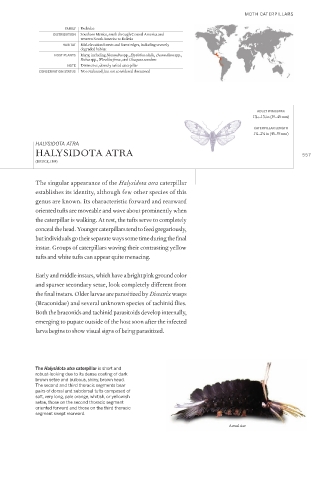
            The singular appearance of the Halysidota atra caterpillar
            establishes its identity, although few other species of this
            genus are known. Its characteristic forward and rearward
            oriented tufts are moveable and wave about prominently when
            the caterpillar is walking. At rest, the tufts serve to completely
            conceal the head. Younger caterpillars tend to feed gregariously,

            but individuals go their separate ways some time during the  nal
            instar. Groups of caterpillars waving their contrasting yellow
            tufts and white tufts can appear quite menacing.


            Early and middle instars, which have a bright pink ground color

            and sparser secondary setae, look completely di erent from
            the  nal instars. Older larvae are parasitized by Distatrix wasps

            (Braconidae) and several unknown species of tachinid flies.
            Both the braconids and tachinid parasitoids develop internally,
            emerging to pupate outside of the host soon after the infected
            larva begins to show visual signs of being parasitized.


            The Halysidota atra caterpillar is short and
            robust-looking due to its dense coating of dark
            brown setae and bulbous, shiny, brown head.
            The second and third thoracic segments bear
            pairs of dorsal and subdorsal tufts composed of
            soft, very long, pale orange, whitish, or yellowish
            setae, those on the second thoracic segment
            oriented forward and those on the third thoracic
            segment swept rearward.
                                                                          Actual size

