


Page 558 - The Book of Caterpillars: A Life-Size Guide to Six Hundred Species From Around the World
P. 558
MOTH CATERPILLARS

                                                     FAMILY  Erebidae
                                                 DISTRIBUTION
                                                 DISTRIBUTION  Areas of North America, Europe, the Middle East, and across Asia
                                                   TRIBUTION
                                                 DIS
                                                          to Siberia and Japan
                                                    HABIT A T  Woodlands, scrub, parks, and gardens
                                                    HABITAT
                                                    HABITAT
                                                  HOS T PLANT S  Various deciduous trees, including alder (Alnus spp.), ash
                                                  HOST PLANTS
                                                  HOST PLANTS
                                                          (Fraxinus spp.), birch (Betula spp.), chestnut (Castanea spp.),
                                                          oak (Quercus spp.), and willow (Salix spp.)
                                                      NOTE
                                                      NO TE  Caterpillar with long hairs that may irritate predators
                                                      NOTE
                                                 A
                                             CONSERVATION STATUS
                                             CONSERVATION STATUS  Not evaluated
                                             CONSERV
                                                      A
                                                      TUS
                                                     T
                                                  TION S
            ADULT WINGSPAN
           1⅜–1¾ in (35–45 mm)


           CATERPILLAR LENGTH
             1 ⁄   in (30 mm)
                                                                             EUPROCTIS SIMILIS
                                                                     YELLOW-TAIL
    556
                                                                                    (FUESSLY, 1775)
                                            Female Yellow-tail moths lay their eggs in batches on leaves of
                                            the host plant. The young caterpillars hatch and are gregarious
                                            at first, staying together in large groups, but as they mature
                                            they disperse and become solitary. Unusually, this species
                                            overwinters on the food plant. The caterpillars become active
                                            again in spring, feeding on young leaves, completing their
                                            development and pupating by June. The pupa is brown black,
                                            enclosed in a creamy-white cocoon.


                                            The common name of the species is derived from the defensive
                                            posture of the adult. When disturbed, the moth—also known as
                                            the Gold-tail Moth or Swan Moth—lies on its side and raises the
                                            tip of its yellow abdomen so that it sticks out beyond the back of

                                            the wings. The moths are night- ying and on the wing during
                                            July and August. Both larvae and moths have irritating hairs to
                                            deter predators. Contact with the hairs can trigger a rash or even
                                            an allergic reaction.


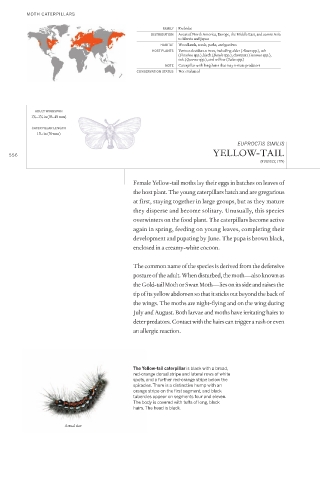
                                            The Yellow-tail caterpillar is black with a broad,
                                            red-orange dorsal stripe and lateral rows of white
                                            spots, and a further red-orange stripe below the
                                            spiracles. There is a distinctive hump with an
                                            orange stripe on the   rst segment, and black
                                            tubercles appear on segments four and eleven.
                                            The body is covered with tufts of long, black
                                            hairs. The head is black.

                      Actual size

