


Page 556 - The Book of Caterpillars: A Life-Size Guide to Six Hundred Species From Around the World
P. 556
MOTH CATERPILLARS

                                                     FAMILY  Erebidae
                                                 DISTRIBUTION  North America, from southern Canada and Maine,
                                                          south to Florida, and west to Texas
                                                    HABITAT  Fields and roadside edges
                                                  HOST PLANTS  Milkweed (Asclepias spp.) and dogbane (Apocynum spp.)
                                                      NOTE  Gregarious caterpillar commonly encountered throughout
                                                          most of its range
                                             CONSERVATION STATUS  Not evaluated, but globally secure, although possibly rare
                                                          at the peripheries of its range


            ADULT WINGSPAN
           1¼–1  ⁄   in (32–43 mm)
           CATERPILLAR LENGTH


             1⅜ in (35 mm)
                                                                              EUCHAETES EGLE
                                                         MILKWEED TUSSOCK
    554
                                                                                     (DRURY, 1773)


                                            The Milkweed Tussock caterpillar, which hatches from a mass
                                            of eggs laid on the underside of leaves, is visually unique. While
                                            early instars are slightly hairy and gray, later instars, at first
                                            glance, look more like a dust mop or pile of discarded yarn than
                                            a life form. The larvae are social feeders until the end of the
                                            third instar. Early instar larvae feed by skeletonizing leaves, and
                                            older caterpillars have developed the trait of pre-severing leaf

                                            veins to reduce the sap  ow of toxic glycosides. A large colony
                                            of these caterpillars can quickly defoliate an entire milkweed
                                            (or dogbane) plant and, unlike Monarch caterpillars (Danaus
                                            plexippus) and other milkweed feeders, prefer mature plants over
                                            younger, more succulent plants.


                                            As a defense when threatened, the caterpillars freeze in place,
                                            then slightly curl their bodies and drop from the host plant into
                                            the leaf litter below. In addition, both caterpillars and adult
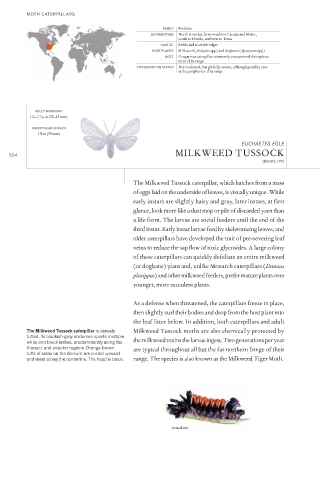
          The Milkweed Tussock caterpillar is densely   Milkweed Tussock moths are also chemically protected by
          tufted. Its blackish-gray abdomen sports multiple   the milkweed toxins the larvae ingest. Two generations per year
          white and black lashes, predominantly along the
          thoracic and anterior regions. Orange-brown   are typical throughout all but the far northern fringe of their
          tufts of setae on the dorsum are curled upward
          and meet along the centerline. The head is black.   range. The species is also known as the Milkweed Tiger Moth.


                                                        Actual size

