


Page 563 - The Book of Caterpillars: A Life-Size Guide to Six Hundred Species From Around the World
P. 563
MOTH CATERPILLARS

                      FAMILY  Erebidae
                  DISTRIBUTION  North and Central America, southern Scandinavia, eastern
                           Europe, western Russia, Mongolia, and northern China to Japan
                     HABITAT  Forests, wet woodlands, parks, and orchards
                  HOST PLANTS  Variety of deciduous and ornamental trees, and also shrubs,
                           including hickory (Carya spp.), walnut (Juglans spp.),
                           apple (Malus spp.), and maple (Acer spp.)
                      NOTE  Widely distributed caterpillar that damages forests and orchards
             CONSERVATION STATUS  Not evaluated


                                                                                   ADULT WINGSPAN
                                                                                   ⁄  –  ⁄   in (15–17 mm)
                                                                                  CATERPILLAR LENGTH
                                                                                  1 ⁄  –1⅜ in (30–35 mm)


            HYPHANTRIA CUNEA
            FALL WEBWORM                                                                         561
            (DRURY, 1773)


            The female Fall Webworm moth lays her eggs in clusters of
            several hundred on the underside of leaves of the food plant. The
            caterpillars are social, living together in huge communal webs
            constructed over the tips of branches of the host plants. When
            feeding, they stay within the protection of the web, which they
            steadily expand. The species overwinters in a brown cocoon
            made of bits of twig and silk. The moths are on the wing from
            midsummer to early fall. There is one generation in the northern
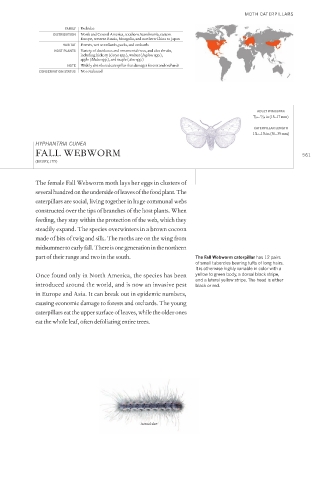
            part of their range and two in the south.          The Fall Webworm caterpillar has 12 pairs
                                                               of small tubercles bearing tufts of long hairs.
                                                               It is otherwise highly variable in color with a
            Once found only in North America, the species has been   yellow to green body, a dorsal black stripe,
            introduced around the world, and is now an invasive pest   and a lateral yellow stripe. The head is either
                                                               black or red.
            in Europe and Asia. It can break out in epidemic numbers,
            causing economic damage to forests and orchards. The young
            caterpillars eat the upper surface of leaves, while the older ones
            eat the whole leaf, often defoliating entire trees.


                                              Actual size

