


Page 562 - The Book of Caterpillars: A Life-Size Guide to Six Hundred Species From Around the World
P. 562
MOTH CATERPILLARS

                                                     FAMILY  Erebidae
                                                 DISTRIBUTION  From southern Ontario, Canada, south through United States
                                                          to Florida, and west to the Midwest, Oklahoma, and Texas
                                                    HABITAT  Meadows and forest edges as well as disturbed areas
                                                  HOST PLANTS  Wide range of frequently toxic plants, from dandelion
                                                          (Taraxacum spp.) to willow (Salix spp.)
                                                      NOTE  Woolly-bear caterpillar frequently found crawling on
                                                          the ground
                                             CONSERVATION STATUS  Not evaluated, but common


            ADULT WINGSPAN
             3 in (76 mm)
           CATERPILLAR LENGTH
             3⅛ in (80 mm)
                                                                        HYPERCOMPE SCRIBONIA
                                                     GIANT LEOPARD MOTH
    560
                                                                                     (STOLL, 1790)


                                            The woolly-bear caterpillars of the Giant Leopard Moth eat
                                            large volumes of leaves as they mature, and are often seen
                                            crawling in search of a suitable food source. Their characteristic
                                            black spines, while probably a good defense against birds, are
                                            harmless to humans. Unlike many other caterpillars, the larvae
                                            easily switch between host plant species, and sometimes search

                                            out speci c plants that are toxic in order to self-medicate against
                                            parasitoids. Adults, too, are chemically defended. Before

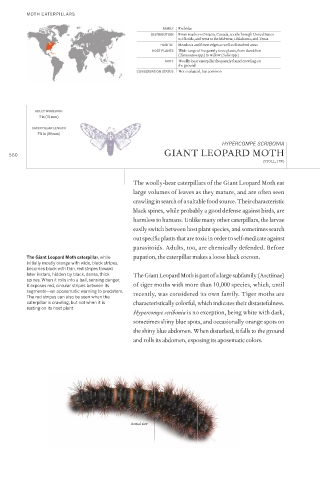
          The Giant Leopard Moth caterpillar, while   pupation, the caterpillar makes a loose black cocoon.
          initially mostly orange with wide, black stripes,
          becomes black with thin, red stripes toward
          later instars, hidden by black, dense, thick   The Giant Leopard Moth is part of a large subfamily (Arctiinae)
          spines. When it rolls into a ball, sensing danger,
          it exposes red, circular stripes between its   of tiger moths with more than 10,000 species, which, until
          segments—an aposematic warning to predators.   recently, was considered its own family. Tiger moths are
          The red stripes can also be seen when the
          caterpillar is crawling, but not when it is   characteristically colorful, which indicates their distastefulness.
          resting on its host plant.
                                            Hypercompe scribonia is no exception, being white with dark,
                                            sometimes shiny blue spots, and occasionally orange spots on
                                            the shiny blue abdomen. When disturbed, it falls to the ground
                                            and rolls its abdomen, exposing its aposematic colors.


                                           Actual size

