


Page 564 - The Book of Caterpillars: A Life-Size Guide to Six Hundred Species From Around the World
P. 564
MOTH CATERPILLARS

                                                     FAMILY  Erebidae
                                                 DISTRIBUTION  The Andes of Venezuela, Colombia, and Ecuador
                                                    HABITAT  Mid-elevation cloud forests and forest edges

                                                  HOST PLANTS  Bombacaceae (one unidenti ed species is currently the only

                                                          con rmed host plant)
                                                      NOTE  Rare, black, fuzzy caterpillar that resembles many in its family
                                             CONSERVATION STATUS  Not evaluated, but not considered threatened


            ADULT WINGSPAN
           1⅞–2 ⁄   in (48–52 mm)
           CATERPILLAR LENGTH
           2⅜–2¾ in (60–70 mm)
                                                                                IDALUS VENETA
                                                                 IDALUS VENETA
    562
                                                                                    (DOGNIN, 1901)


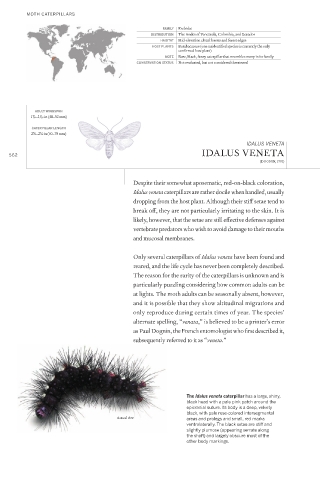
                                            Despite their somewhat aposematic, red-on-black coloration,
                                            Idalus veneta caterpillars are rather docile when handled, usually
                                            dropping from the host plant. Although their sti  setae tend to

                                            break o , they are not particularly irritating to the skin. It is

                                            likely, however, that the setae are still e ective defenses against

                                            vertebrate predators who wish to avoid damage to their mouths
                                            and mucosal membranes.


                                            Only several caterpillars of Idalus veneta have been found and
                                            reared, and the life cycle has never been completely described.
                                            The reason for the rarity of the caterpillars is unknown and is
                                            particularly puzzling considering how common adults can be
                                            at lights. The moth adults can be seasonally absent, however,
                                            and it is possible that they show altitudinal migrations and
                                            only reproduce during certain times of year. The species’
                                            alternate spelling, “venata,” is believed to be a printer’s error
                                            as Paul Dognin, the French entomologist who  rst described it,

                                            subsequently referred to it as “veneta.”


                                                             The Idalus veneta caterpillar has a large, shiny,
                                                             black head with a pale pink patch around the
                                                             epicranial suture. Its body is a deep, velvety
                                                             black, with pale rose-colored intersegmental
                                      Actual size            areas and prolegs and small, red marks
                                                             ventrolaterally. The black setae are sti   and
                                                             slightly plumose (appearing serrate along
                                                             the shaft) and largely obscure most of the
                                                             other body markings.

