


Page 576 - The Book of Caterpillars: A Life-Size Guide to Six Hundred Species From Around the World
P. 576
MOTH CATERPILLARS

                                                     FAMILY  Erebidae
                                                 DISTRIBUTION  Colombia and Ecuador
                                                    HABITAT  Lower temperate and upper subtropical forest borders
                                                  HOST PLANTS  Mikania micrantha
                                                      NOTE  Caterpillar of a rare and poorly studied species
                                             CONSERVATION STATUS  Not evaluated, but not considered threatened


            ADULT WINGSPAN
           1 ⁄  –1½ in (30–38 mm)
           CATERPILLAR LENGTH
           2–2⅛ in (50–55 mm)
                                                                             PHAIO CEPHALENA
                                                            PHAIO CEPHALENA
    574
                                                                                     (DRUCE, 1883)


                                            The distinctive Phaio cephalena caterpillar is very rarely
                                            encountered, although the adults can be fairly common,
                                            at least in northeastern Ecuador. Indeed, to date, the caterpillars
                                            of P. cephalena have only been found and reared twice, and in
                                            both instances they were discovered as solitary individuals,
                                            suggesting that the adult female lays her eggs one at a time. The
                                            reasons for the scarcity of larval records are unknown, but,
                                            as some species of their host plant genus commonly grow as
                                            high-climbing vines, the larvae may, in fact, be much more
                                            common in the poorly explored canopy habitats within their
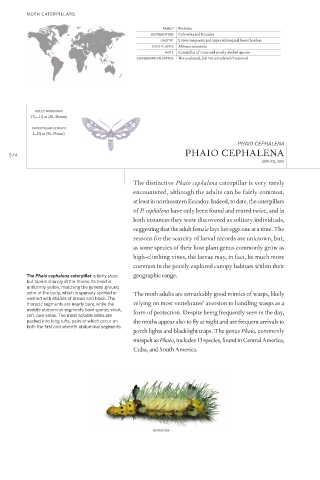
          The Phaio cephalena caterpillar is fairly stout   geographic range.
          but tapers sharply at the thorax. Its head is
          uniformly yellow, matching the general ground
          color of the body, which is sparsely spotted or   The moth adults are remarkably good mimics of wasps, likely
          washed with shades of brown and black. The
          thoracic segments are nearly bare, while the   relying on most vertebrates’ aversion to handling wasps as a
          middle abdominal segments have sparse, short,   form of protection. Despite being frequently seen in the day,
          soft, pale setae. The most notable setae are

          packed into long tufts, pairs of which occur on   the moths appear also to  y at night and are frequent arrivals to
          both the   rst and seventh abdominal segments.
                                            porch lights and blacklight traps. The genus Phaio, commonly
                                            misspelt as Phaeo, includes 13 species, found in Central America,
                                            Cuba, and South America.


                                                  Actual size

