


Page 577 - The Book of Caterpillars: A Life-Size Guide to Six Hundred Species From Around the World
P. 577
MOTH CATERPILLARS

                      FAMILY  Erebidae
                  DISTRIBUTION  Eastern Australia, Papua New Guinea, and New Caledonia
                     HABITAT  Subtropical forests below 1,970 ft (600 m) elevation
                  HOST PLANTS  Menispermaceae, including Carronia Vine (Carronia multisepalea)
                           and Pycnarrhena australiana
                      NOTE  Spectacular caterpillar that has false eyes and a defensive posture
             CONSERVATION STATUS  Not evaluated, but the southern subspecies is endangered


                                                                                   ADULT WINGSPAN
                                                                                  5–6¾ in (130–170 mm)
                                                                                  CATERPILLAR LENGTH
            PHYLLODES IMPERIALIS                                                    4⅝ in (120 mm)
            IMPERIAL
            FRUIT-SUCKING MOTH                                                                   575

            DRUCE, 1888


            The female Imperial Fruit-sucking Moths lay their eggs
            singly on vines of the Menispermaceae family, choosing young
            leaves on low-growing plants in heavily shaded areas. Once
            hatched, the caterpillars feed on leaves and, at rest, lie flat


            against the stems, their dead-lea ike camou age making them
            difficult to spot among the foliage. The mature larvae crawl
            to the ground and pupate in a loose cocoon in the leaf litter.
            The resulting pupae have a bronze color.


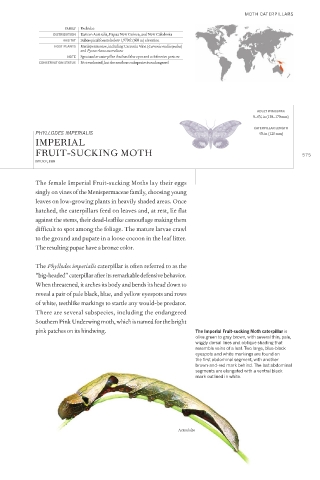
            The Phyllodes imperialis caterpillar is often referred to as the
            “big-headed” caterpillar after its remarkable defensive behavior.
            When threatened, it arches its body and bends its head down to
            reveal a pair of pale black, blue, and yellow eyespots and rows
            of white, teethlike markings to startle any would-be predator.
            There are several subspecies, including the endangered
            Southern Pink Underwing moth, which is named for the bright
            pink patches on its hindwing.                      The Imperial Fruit-sucking Moth caterpillar is
                                                               olive green to gray brown, with several thin, pale,
                                                               wiggly dorsal lines and oblique shading that
                                                               resemble veins of a leaf. Two large, blue-black
                                                               eyespots and white markings are found on
                                                               the   rst abdominal segment, with another
                                                               brown-and-red mark behind. The last abdominal
                                                               segments are elongated with a ventral black
                                                               mark outlined in white.


                                                          Actual size

