


Page 578 - The Book of Caterpillars: A Life-Size Guide to Six Hundred Species From Around the World
P. 578
MOTH CATERPILLARS

                                                     FAMILY  Erebidae
                                                 DISTRIBUTION  Venezuela, Ecuador, Peru, and likely also Colombia
                                                    HABITAT  Cloud forests and forest borders
                                                  HOST PLANTS  Many, including Saurauia bullosa Wawra, Anthurium spp., Baccaris
                                                          spp., Brunnelia spp., Erythrina edulis, and Tibouchina lepidota
                                                      NOTE  Common caterpillar that has distinctive, long tufts of orange setae
                                             CONSERVATION STATUS  Not evaluated, but not considered threatened


            ADULT WINGSPAN
           2¾–3⅛ in (70–80 mm)
           CATERPILLAR LENGTH
           2 ⁄  –3 in (65–75 mm)
                                                                      PRAEAMASTUS ALBIPUNCTA
                                             PRAEAMASTUS ALBIPUNCTA
    576
                                                                                   (HAMPSON, 1901)


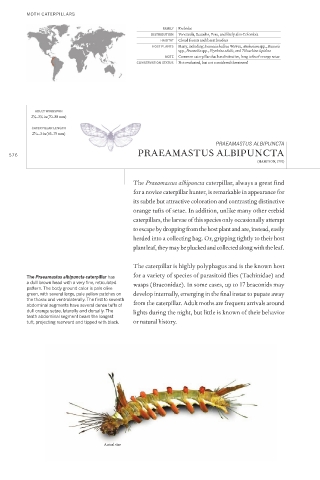
                                            The Praeamastus albipuncta caterpillar, always a great find
                                            for a novice caterpillar hunter, is remarkable in appearance for
                                            its subtle but attractive coloration and contrasting distinctive
                                            orange tufts of setae. In addition, unlike many other erebid
                                            caterpillars, the larvae of this species only occasionally attempt
                                            to escape by dropping from the host plant and are, instead, easily
                                            herded into a collecting bag. Or, gripping tightly to their host
                                            plant leaf, they may be plucked and collected along with the leaf.


                                            The caterpillar is highly polyphagus and is the known host
                                            for a variety of species of parasitoid flies (Tachinidae) and
          The Praeamastus albipuncta caterpillar has
          a dull brown head with a very   ne, reticulated   wasps (Braconidae). In some cases, up to 17 braconids may
          pattern. The body ground color is pale olive

          green, with several large, pale yellow patches on   develop internally, emerging in the  nal instar to pupate away
          the thorax and ventrolaterally. The   rst to seventh   from the caterpillar. Adult moths are frequent arrivals around
          abdominal segments have several dense tufts of
          dull orange setae, laterally and dorsally. The   lights during the night, but little is known of their behavior
          tenth abdominal segment bears the longest
          tuft, projecting rearward and tipped with black.  or natural history.


                                  Actual size

