


Page 579 - The Book of Caterpillars: A Life-Size Guide to Six Hundred Species From Around the World
P. 579
MOTH CATERPILLARS

                      FAMILY  Erebidae
                  DISTRIBUTION  Southern Canada, United States, and northern Mexico
                     HABITAT  Forests, temperate rain forests, grasslands, and meadows
                  HOST PLANTS  Various, including grasses, dandelion (Taraxacum spp.), nettle
                           (Urtica spp.), plantain (Plantago spp.), and dock (Rumex spp.)
                      NOTE  Caterpillar that is equipped with “antifreeze” to survive
                           cold winters
             CONSERVATION STATUS  Not evaluated


                                                                                   ADULT WINGSPAN
                                                                                  1¾–2⅛ in (45–55 mm)
                                                                                  CATERPILLAR LENGTH
                                                                                  1 ⁄  –2 in (40–50 mm)
            PYRRHARCTIA ISABELLA
            BANDED WOOLLY BEAR                                                                   577

            (J. E. SMITH, 1797)


            Banded Woolly Bear caterpillars hatch from eggs laid in large
            clusters on bark in the fall and then overwinter. In the northern
            parts of their range, the larvae can survive freezing temperatures
            in winter due to the presence of “antifreeze” chemicals in their
            cells. In spring, they become active and start feeding. The adult
            moths are on the wing in summer.

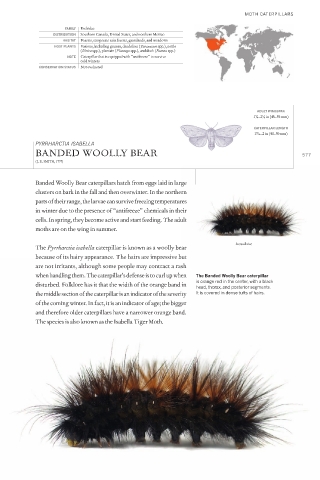
            The Pyrrharctia isabella caterpillar is known as a woolly bear   Actual size
            because of its hairy appearance. The hairs are impressive but
            are not irritants, although some people may contract a rash
            when handling them. The caterpillar’s defense is to curl up when   The Banded Woolly Bear caterpillar
            disturbed. Folklore has it that the width of the orange band in   is orange red in the center, with a black
                                                                head, thorax, and posterior segments.
            the middle section of the caterpillar is an indicator of the severity   It is covered in dense tufts of hairs.
            of the coming winter. In fact, it is an indicator of age; the bigger
            and therefore older caterpillars have a narrower orange band.
            The species is also known as the Isabella Tiger Moth.

