


Page 581 - The Book of Caterpillars: A Life-Size Guide to Six Hundred Species From Around the World
P. 581
MOTH CATERPILLARS

                      FAMILY  Erebidae
                  DISTRIBUTION  North America, from southern Canada south to Mexico
                     HABITAT  Woodlands, scrub, wastelands, parks, and gardens
                  HOST PLANTS  More than 100 low-growing plants, trees, and shrubs, including
                           Pinto Bean (Phaseolus vulgaris), Soybean (Glycine max),
                           and Corn (Zea mays)
                      NOTE  Caterpillar covered in hairs that can irritate
             CONSERVATION STATUS  Not evaluated


                                                                                   ADULT WINGSPAN
                                                                                  1¼–2 ⁄   in (32–53 mm)
                                                                                  CATERPILLAR LENGTH
                                                                                    2⅜ in (60 mm)
            SPILOSOMA VIRGINICA
            YELLOW WOOLLY BEAR                                                                   579

            (FABRICIUS, 1798)


            Yellow Woolly Bear caterpillars hatch from yellow eggs laid
            in large clusters of up to 100 on the underside of leaves. The
            young caterpillars are gregarious but disperse as they get older.
            The larvae are active from May to November. There are two
            generations over the summer months, with the pupae of the
            second generation overwintering on the ground in the leaf litter.
            The cocoon consists of silk threads and brown hairs, so it is well
            disguised among the dead leaves.


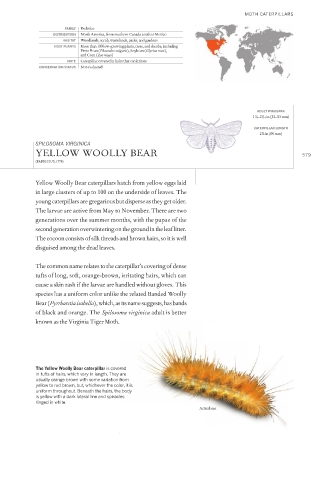
            The common name relates to the caterpillar’s covering of dense
            tufts of long, soft, orange-brown, irritating hairs, which can
            cause a skin rash if the larvae are handled without gloves. This
            species has a uniform color unlike the related Banded Woolly
            Bear (Pyrrharctia isabella), which, as its name suggests, has bands
            of black and orange. The Spilosoma virginica adult is better
            known as the Virginia Tiger Moth.


            The Yellow Woolly Bear caterpillar is covered
            in tufts of hairs, which vary in length. They are
            usually orange brown with some variation from
            yellow to red brown, but, whichever the color, it is
            uniform throughout. Beneath the hairs, the body
            is yellow with a dark lateral line and spiracles
            ringed in white.
                                                                 Actual size

