


Page 580 - The Book of Caterpillars: A Life-Size Guide to Six Hundred Species From Around the World
P. 580
MOTH CATERPILLARS

                                                     FAMILY  Erebidae
                                                 DISTRIBUTION  Eastern Ecuador, but also likely into northern Peru and possibly
                                                          southern Colombia
                                                    HABITAT  Forest edges, light gaps, and revegetating landslides
                                                  HOST PLANTS  Many, especially the evergreen bamboo Chusquea scandens;
                                                          also Piper baezanum and P. augustum Rudge, Miriocarpa spp.,
                                                          Boehmeria bullata, and Casearia spp.
                                                      NOTE  Caterpillar that plucks and weaves its setae into a cocoon
                                             CONSERVATION STATUS  Not evaluated, but not considered threatened


            ADULT WINGSPAN
            ¾–⅞ in (19–22 mm)
           CATERPILLAR LENGTH
            ¾–1 in (20–25 mm)
                                                                               SAURITA MOSCA
                                                                 SAURITA MOSCA
    578
                                                                                    (DOGNIN, 1897)


                                            The highly polyphagous Saurita mosca caterpillars are found
                                            singly on their many and varied hosts but most commonly on
                                            bamboo, which is ubiquitous within their montane habitats.
                                            Through most of their life cycle, the larvae are relatively
                                            devoid of setae but grow dense tufts in the  nal instar. Prior to

                                            pupation, they pluck these tufts of setae and spin them into a thin,
                                            dome-shaped cocoon, within which they pupate. This barrier
                                            of setae and silk is presumably an effective defense against
                                            predators such as ants.


                                            The caterpillars are heavily parasitized by braconid and
                                            ichneumonid wasps, as well as by tachinid  ies. Most of these

                                            parasitoids emerge from late instars and pupate away from the
                                            host, except for some of the ichneumonids, which pupate inside
                                            the Saurita mosca larva, and one tachinid species that emerges
                                            from the pupa. The adult moths, which fly by both day and
                                            night, are convincing wasp mimics, although little is known
                                            of their general behavior.


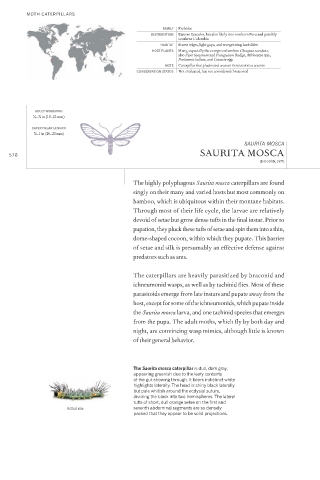
                                            The Saurita mosca caterpillar is dull, dark gray,
                                            appearing greenish due to the leafy contents
                                            of the gut showing through. It bears indistinct white
                                            highlights laterally. The head is shiny black laterally
                                            but pale whitish around the ecdysial suture,
                                            dividing the black into two hemispheres. The lateral
                                            tufts of short, dull orange setae on the   rst and
                      Actual size           seventh abdominal segments are so densely
                                            packed that they appear to be solid projections.

