


Page 582 - The Book of Caterpillars: A Life-Size Guide to Six Hundred Species From Around the World
P. 582
MOTH CATERPILLARS

                                                     FAMILY  Erebidae
                                                 DISTRIBUTION  Poorly known, with records only from western Colombia and
                                                          eastern Ecuador
                                                    HABITAT  Cloud forests and secondary growth of montane forests at around
                                                          7,200 ft (2,200 m) elevation
                                                  HOST PLANTS  Gunnera spp., Miconia spp., and Tibouchina lepidota
                                                      NOTE  Caterpillar that in most instars feeds in large groups
                                             CONSERVATION STATUS  Not evaluated, but not considered threatened


            ADULT WINGSPAN
           1⅝–1⅞ in (41–47 mm)
           CATERPILLAR LENGTH
           2–2 ⁄   in (50–65 mm)
                                                                           SYMPHLEBIA PALMERI
                                                        SYMPHLEBIA PALMERI
    580
                                                                                 (ROTHSCHILD, 1910)


                                            Symphlebia palmeri caterpillars feed and rest in groups during

                                            most of their life, apparently separating only late in the  nal
                                            instar or just prior to pupation. Pupation has not been observed
                                            in nature but seems likely to occur away from the host plant,
                                            as caterpillars held in bags in the laboratory often exhibit a day
                                            or more of wandering behavior prior to pupation. Their setae,
                                            unlike those of many other erebid species, appear to be only
                                            mildly urticating. When the caterpillar is in motion, or stretched
                                            out to feed, the otherwise uniform coating of setae across the
                                            back will appear broken into segmental rings or individual tufts,
                                            giving it an orange-on-black, potentially aposematic look.


                                            The adults are common visitors to lights at night and, despite
                                            their striking coloration, are remarkably cryptic when at
                                            rest, with wings folded over their back, making them appear
                                            much like a dead, damaged, or moldy leaf. The patchy
                                            nature of the known range of the species suggests that it may
                                            go overlooked in many areas or that more than one species
                                            may be involved.


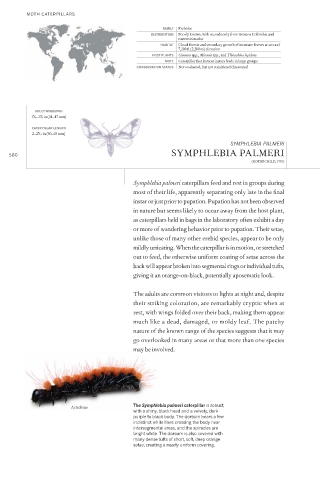
                        Actual size         The Symphlebia palmeri caterpillar is robust,
                                            with a shiny, black head and a velvety, dark
                                            purple to black body. The dorsum bears a few
                                            indistinct white lines crossing the body near
                                            intersegmental areas, and the spiracles are
                                            bright white. The dorsum is also covered with
                                            many dense tufts of short, soft, deep orange
                                            setae, creating a nearly uniform covering.

