


Page 583 - The Book of Caterpillars: A Life-Size Guide to Six Hundred Species From Around the World
P. 583
MOTH CATERPILLARS

                      FAMILY  Erebidae
                  DISTRIBUTION  Southeastern United States, from the coastal regions of Georgia
                           into Florida, the Caribbean, Central America, and northern
                           South America
                     HABITAT  Cultivated landscapes, pinelands, and coastal areas
                  HOST PLANTS  Oleander (Nerium oleander), Devil’s-potato (Echites umbellata),
                           Rubber Vine (Cryptostegia grandi ora), and Desert Rose

                           (Adenium obesum)
                      NOTE  Caterpillar that is gregarious in early instars and during pupation
             CONSERVATION STATUS  Not evaluated, but common


                                                                                   ADULT WINGSPAN
                                                                                   1  ⁄   in (43 mm)
                                                                                  CATERPILLAR LENGTH
                                                                                    1 ⁄   in (40 mm)
            SYNTOMEIDA EPILAIS
            POLKA-DOT WASP MOTH                                                                  581

            (WALKER, 1854)


            Polka-dot Wasp Moth caterpillars hatch from pale, spherical
            eggs laid in clusters of 12 to 75, usually on the underside of
            Oleander leaves. Their native host plants are Devil’s-potato
            or Rubber Vine, which are now relatively local and rare;
            Oleander, introduced from the Mediterranean, has become the
            major food source, and the larvae are now considered a pest on
            this ornamental plant. Early instars feed gregariously and can
            completely defoliate their host plants. Later stages feed solitarily,
            but pupation can occur in groups; the pupae are encased in thin
            cocoons into which hairs from the caterpillars are woven.


            The larvae may be protected from bird predation by their
            setae, aposematic coloring, and toxic chemicals. Predatory
            stink bugs, parasitic tachinid  ies, wasps, and  re ants are their


            main enemies. The Polka-dot Wasp Moth breeds year-round
            in south Florida and the Caribbean but is killed by cold spells in
            the northern part of its range, which it recolonizes the following
            spring. The species belongs to a fascinating wasp-mimicking
            group within the erebid family, which includes many moths
            that are diurnal, brightly colored, and sometimes practically
            impossible to tell apart from real wasps.


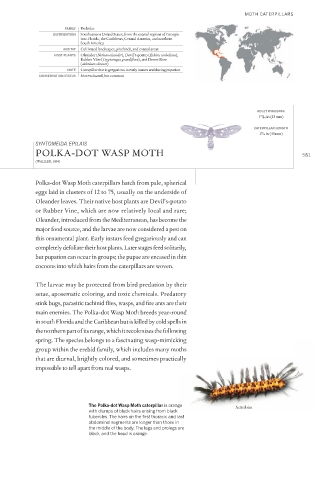
                             The Polka-dot Wasp Moth caterpillar is orange   Actual size
                             with clumps of black hairs arising from black
                             tubercles. The hairs on the   rst thoracic and last
                             abdominal segments are longer than those in
                             the middle of the body. The legs and prolegs are
                             black, and the head is orange.

