


Page 584 - The Book of Caterpillars: A Life-Size Guide to Six Hundred Species From Around the World
P. 584
MOTH CATERPILLARS

                                                     FAMILY  Erebidae
                                                 DISTRIBUTION  Western North America, Europe, Middle East, and area of
                                                          central Asia, east to northern China; also New Zealand
                                                    HABITAT  Scrub, grasslands, and wastelands
                                                  HOST PLANTS  Ragwort (Senecio jacobaea) and Groundsel (Senecio vulgaris)
                                                      NOTE  Striking caterpillar that gains its toxicity from its host plant
                                             CONSERVATION STATUS  Not evaluated, but quite common


            ADULT WINGSPAN

           1⅜–1¾ in (35–45 mm)

           CATERPILLAR LENGTH
             1 ⁄   in (30 mm)
                                                                              TYRIA JACOBAEAE
                                                                          CINNABAR
    582
                                                                                   (LINNAEUS, 1758)


                                            Cinnabar moth caterpillars hatch from eggs laid in clutches of
                                            up to 40 on the underside of leaves. The caterpillars are yellow
                                            at  rst but soon gain their characteristic stripes. The larvae are

                                            gregarious and quickly defoliate food plants, hence their value as
                                            a control agent for Ragwort, which is classed as a noxious weed.
                                            For this reason, the species has been introduced to New Zealand
                                            and Tasmania. When fully developed, the caterpillars pupate
                                            on the ground, and the pupae overwinter in a sparse cocoon
                                            within the leaf litter. The red, day- ying adult moths are on the

                                            wing from May to July.

                                            The caterpillar is one of the world’s most poisonous larvae,
                                            gaining its toxicity from the host plant, Ragwort, which is
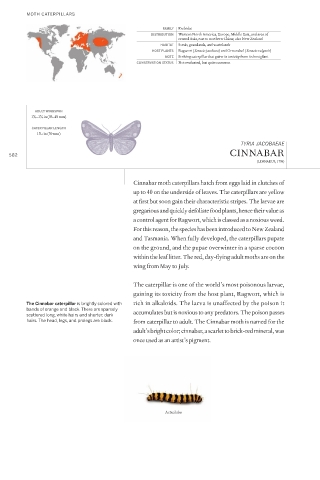
         The Cinnabar caterpillar is brightly colored with   rich in alkaloids. The larva is unaffected by the poison it
         bands of orange and black. There are sparsely   accumulates but is noxious to any predators. The poison passes
         scattered long, white hairs and shorter, dark
         hairs. The head, legs, and prolegs are black.   from caterpillar to adult. The Cinnabar moth is named for the
                                            adult’s bright color; cinnabar, a scarlet to brick-red mineral, was
                                            once used as an artist’s pigment.


                                                      Actual size

