


Page 585 - The Book of Caterpillars: A Life-Size Guide to Six Hundred Species From Around the World
P. 585
MOTH CATERPILLARS

                      FAMILY  Erebidae
                  DISTRIBUTION  North and South America, from Nova Scotia south to Argentina,
                           including the Caribbean
                     HABITAT  Meadows and forest edges, in close association with host plants
                  HOST PLANTS  Rattlebox plants in the genus Crotalaria (Fabaceae family)
                      NOTE  Brightly striped caterpillar whose colors advertise its
                           unpleasant taste
             CONSERVATION STATUS  Not evaluated, but common


                                                                                   ADULT WINGSPAN
                                                                                  1
–1¾ in (30–45 mm)
                                                                                  CATERPILLAR LENGTH
                                                                                  1
–1
 in (30–40 mm)
            UTETHEISA ORNATRIX
            ORNATE BELLA MOTH                                                                    583

            (LINNAEUS, 1758)


            Initially, Ornate Bella Moth caterpillars feed in groups on
            the underside of leaves but are solitary during later instars
            as they seek out and penetrate the seedpods of rattlebox plants
            in order to consume nutritious, alkaloid-rich seeds. From these
            they derive not only nutrients but also toxic chemicals called
            pyrrolizidine alkaloids, which are passed on to the adult and
            help protect against predators at all stages of development.

            Growing rapidly, the larvae reach the  nal instar in three weeks
            and spin spiderweb-like silk, with which to enclose the pupae
            in a loose layer.


            For its intriguing handling of the toxic alkaloids, which are also
            transformed by males into pheromones, the species has served as
            a model for research into chemical ecology. It is closely related   The Ornate Bella Moth caterpillar is
            to about 40 members of the genus Utetheisa, which form several   aposematically colored in orange-and-black
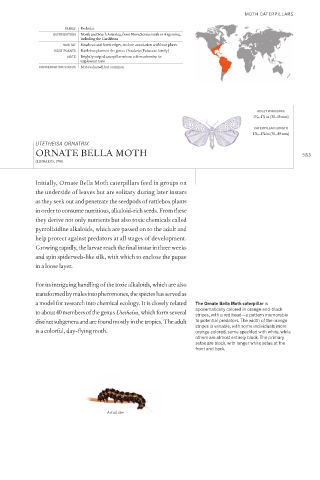
                                                               stripes, with a red head—a pattern memorable
            distinct subgenera and are found mostly in the tropics. The adult   to potential predators. The width of the orange
            is a colorful, day- ying moth.                     stripes is variable, with some individuals more

                                                               orange-colored, some speckled with white, while
                                                               others are almost entirely black. The primary
                                                               setae are black, with longer white setae at the
                                                               front and back.


                                   Actual size

