


Page 589 - The Book of Caterpillars: A Life-Size Guide to Six Hundred Species From Around the World
P. 589
MOTH CATERPILLARS


                      FAMILY  Nolidae
                  DISTRIBUTION  The Himalayas, South and Southeast Asia, southern China,
                           and Chinese Taipei
                     HABITAT  Lowland and montane forests
                  HOST PLANTS  Myrtaceae, including Eugenia spp., Rose Myrtle (Rhodomyrtus
                           tomentosa), Campomanesia xanthocarpa, Cleistocalyx operculatus,
                           and Java Plum (Syzygium cumini)
                      NOTE  Caterpillar that mimics unpalatable berries
             CONSERVATION STATUS  Not evaluated, but common


                                                                                   ADULT WINGSPAN
                                                                                  1 ⁄  –1¾ in (40–45 mm)
                                                                                  CATERPILLAR LENGTH
                                                                                    1 in (25 mm)
            CAREA VARIPES
            CAREA VARIPES                                                                        587

            WALKER, 1856


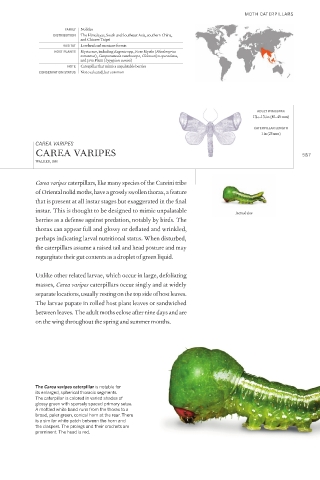
            Carea varipes caterpillars, like many species of the Careini tribe
            of Oriental nolid moths, have a grossly swollen thorax, a feature
            that is present at all instar stages but exaggerated in the  nal

            instar. This is thought to be designed to mimic unpalatable     Actual size
            berries as a defense against predation, notably by birds. The
            thorax can appear full and glossy or deflated and wrinkled,
            perhaps indicating larval nutritional status. When disturbed,
            the caterpillars assume a raised tail and head posture and may
            regurgitate their gut contents as a droplet of green liquid.


            Unlike other related larvae, which occur in large, defoliating
            masses, Carea varipes caterpillars occur singly and at widely
            separate locations, usually resting on the top side of host leaves.
            The larvae pupate in rolled host plant leaves or sandwiched
            between leaves. The adult moths eclose after nine days and are
            on the wing throughout the spring and summer months.


            The Carea varipes caterpillar is notable for
            its enlarged, spherical thoracic segments.
            The caterpillar is colored in varied shades of
            glossy green with sparsely spaced primary setae.
            A mottled white band runs from the thorax to a
            broad, paler green, conical horn at the rear. There
            is a similar white patch between the horn and
            the claspers. The prolegs and their crochets are
            prominent. The head is red.

