


Page 592 - The Book of Caterpillars: A Life-Size Guide to Six Hundred Species From Around the World
P. 592
MOTH CATERPILLARS

                                                     FAMILY  Nolidae
                                                 DISTRIBUTION  Across Europe into western Russia; also Japan
                                                    HABITAT  Woodlands, scrub, parks, and gardens
                                                  HOST PLANTS  Various deciduous trees, including alder (Alnus spp.),
                                                          birch (Betula spp.), and oak (Quercus spp.)
                                                      NOTE  Plump, green caterpillar that pupates in a boat-shaped cocoon
                                             CONSERVATION STATUS  Not evaluated


            ADULT WINGSPAN
           1 ⁄  –1¾ in (30–45 mm)
           CATERPILLAR LENGTH
             1⅜ in (35 mm)


                                                                        PSEUDOIPS PRASINANUS
                                                          GREEN SILVER-LINES
    590
                                                                                   (LINNAEUS, 1758)


                                            The caterpillars of the Green Silver-lines moth emerge from
                                            reddish-brown,  attened eggs laid in batches of up to 250 on the

                                            underside of leaves. The larvae rest on the leaf underside during
                                            the day and become active at night. They crawl down the tree
                                            to pupate in a crevice in the bark or in the leaf litter, spinning a
                                            brown, boat-shaped cocoon. The pupa overwinters and ecloses
                                            the following spring.


                                            The adult moths are bright green in color and are on the
                                            wing in June and July. There is usually a single generation,
                                            but occasionally a second generation appears in late summer.
                                            The moths rest on tree trunks during the day, fly at night,
                                            and are attracted to light. The common name derives from
                                            the distinctive silvery, diagonal lines on the green forewings.
                                            The equally green caterpillars can be seen from mid-July to
                                            as late as October.


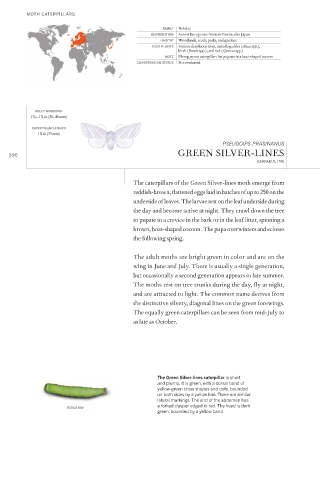
                                                   The Green Silver-lines caterpillar is short
                                                   and plump. It is green, with a dorsal band of
                                                   yellow-green cross shapes and dots, bounded
                                                   on both sides by a yellow line. There are similar
                                                   lateral markings. The end of the abdomen has
                      Actual size                  a forked clasper edged in red. The head is dark
                                                   green, bounded by a yellow band.

