


Page 587 - The Book of Caterpillars: A Life-Size Guide to Six Hundred Species From Around the World
P. 587
MOTH CATERPILLARS

                      FAMILY  Euteliidae
                  DISTRIBUTION  Northern Thailand, southeast China, Chinese Taipei, and Japan
                     HABITAT  Forests and gardens
                  HOST PLANTS  Spondias spp.
                      NOTE  Candy-striped caterpillar that has a distinctive swollen thorax
             CONSERVATION STATUS  Not evaluated, and relatively unknown, although not
                           uncommon regionally


                                                                                   ADULT WINGSPAN
                                                                                  1 ⁄  –1⅜ in (30–35 mm)


                                                                                  CATERPILLAR LENGTH


                                                                                    1⅜ in (35 mm)
            PHALGA CLARIRENA
            PHALGA CLARIRENA                                                                     585
            (SUGI, 1982)


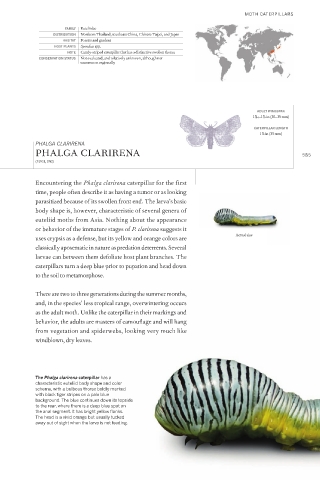
            Encountering the Phalga clarirena caterpillar for the first
            time, people often describe it as having a tumor or as looking
            parasitized because of its swollen front end. The larva’s basic
            body shape is, however, characteristic of several genera of
            euteliid moths from Asia. Nothing about the appearance
            or behavior of the immature stages of P. clarirena suggests it
            uses crypsis as a defense, but its yellow and orange colors are   Actual size
            classically aposematic in nature as predation deterrents. Several
            larvae can between them defoliate host plant branches. The
            caterpillars turn a deep blue prior to pupation and head down
            to the soil to metamorphose.


            There are two to three generations during the summer months,
            and, in the species’ less tropical range, overwintering occurs
            as the adult moth. Unlike the caterpillar in their markings and
            behavior, the adults are masters of camou age and will hang

            from vegetation and spiderwebs, looking very much like
            windblown, dry leaves.


            The Phalga clarirena caterpillar has a
            characteristic euteliid body shape and color
            scheme, with a bulbous thorax boldly marked
            with black tiger stripes on a pale blue
            background. The blue continues down its topside
            to the rear, where there is a deep blue spot on
            the anal segment. It has bright yellow   anks.
            The head is a vivid orange but usually tucked
            away out of sight when the larva is not feeding.

