


Page 591 - The Book of Caterpillars: A Life-Size Guide to Six Hundred Species From Around the World
P. 591
MOTH CATERPILLARS

                      FAMILY  Nolidae
                  DISTRIBUTION  Europe, North Africa, the Middle East, and across northern Asia
                           to Russian Far East; also Canada (British Columbia)
                     HABITAT  Woodlands, hedgerows, and gardens
                  HOST PLANTS  Rosaceae family, including Cotoneaster spp., Malus spp.,
                           Prunus spp., and Sorbus spp.
                      NOTE  Small, hairy caterpillar that is found in woodlands and hedgerows
             CONSERVATION STATUS  Not evaluated, but not considered to be at risk


                                                                                   ADULT WINGSPAN
                                                                                   ⁄  –¾ in (15–20 mm)
                                                                                  CATERPILLAR LENGTH
                                                                                    ¾ in (20 mm)
            NOLA CUCULLATELLA
            SHORT-CLOAKED MOTH                                                                   589

            (LINNAEUS, 1758)


            The caterpillars of the Short-cloaked Moth hatch from ribbed,
            round eggs laid on leaves of the host plant. The young larvae

            feed brie y after hatching, before crawling into small cracks
            in the bark, where they spend the winter. They become active
            again in late spring. The cocoon, which is found attached to
            twigs, is made from silk, hairs, and pieces of wood, giving it
            a pale brown coloration.


            The moths—nocturnal and attracted to light—are on the
            wing in June and July, and there is a single generation. Nola
            cucullatella is widespread across Europe and northern Asia,
            and recently it has been discovered near the port of Vancouver
            in British Columbia, Canada, where it most likely arrived in
            cargo. The species gets its common name from the dark, basal
            coloring on the wings, which, when the wings are folded at rest,
            creates the appearance of a short cloak. The species name comes
            from the Latin word cuculla, meaning “hood.”


                                                                           Actual size
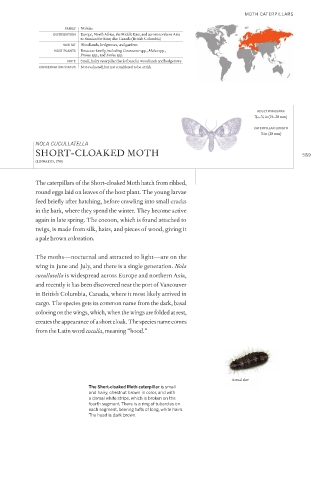
                             The Short-cloaked Moth caterpillar is small
                             and hairy, chestnut brown in color, and with
                             a dorsal white stripe, which is broken on the
                             fourth segment. There is a ring of tubercles on
                             each segment, bearing tufts of long, white hairs.
                             The head is dark brown.

