


Page 590 - The Book of Caterpillars: A Life-Size Guide to Six Hundred Species From Around the World
P. 590
MOTH CATERPILLARS

                                                     FAMILY  Nolidae
                                                 DISTRIBUTION  Southern Europe, central Europe, southern Russia,
                                                          southern Scandanavia, and Turkey
                                                    HABITAT  Warm and wet riparian forests
                                                  HOST PLANTS  White Poplar (Populus alba)

                                                      NOTE  Pale gray caterpillar that is covered in  ne hairs
                                             CONSERVATION STATUS  Not evaluated


            ADULT WINGSPAN
            ¾–1 in (20–25 mm)
           CATERPILLAR LENGTH
            ⁄  –¾ in (15–20 mm)
                                                                              EARIAS VERNANA
                                                   SILVER POPLAR SPINNER
    588
                                                                                   (FABRICIUS, 1787)


                                            The caterpillars of the Silver Poplar Spinner moth hatch from
                                            eggs that are laid on the leaves of the host plant. The larvae feed
                                            on leaves at the end of branches, where they live within a leaf
                                            shelter secured by silk. The mature caterpillar spins a pale brown
                                            cocoon on a stem or twig in which to pupate and overwinter.


                                            The night- ying moths are on the wing from April to August,
                                            and there are usually two generations a year, from April to
                                            June and July to August. In the south of the range, there may
                                            even be a third generation, while in the more northerly regions
                                            a single generation is more usual. The species is less common in
                                            the north, where it is increasingly rare due to the loss of riparian
                                            forests. Earias vernana is often mistaken for E. clorana, which is
                                            found in similar habitats.


                     Actual size
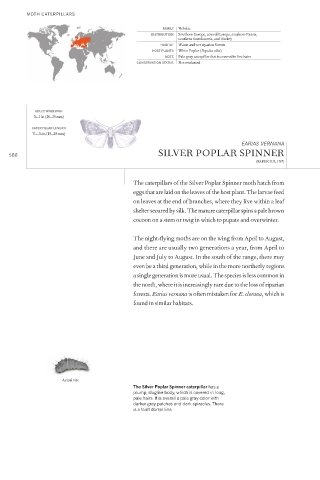
                                            The Silver Poplar Spinner caterpillar has a
                                            plump, sluglike body, which is covered in long,
                                            pale hairs. It is overall a pale gray color with
                                            darker gray patches and dark spiracles. There
                                            is a faint dorsal line.

