


Page 588 - The Book of Caterpillars: A Life-Size Guide to Six Hundred Species From Around the World
P. 588
MOTH CATERPILLARS

                                                     FAMILY  Nolidae
                                                 DISTRIBUTION
                                                 DISTRIBUTION  Across Europe into western Asia and northern Iran
                                                   TRIBUTION
                                                 DIS
                                                    HABIT A T  Woodlands and parks
                                                    HABITAT
                                                    HABITAT
                                                  HOS T PLANT S  Oak (Quercus spp.)
                                                  HOST PLANTS
                                                  HOST PLANTS
                                                      NO
                                                      NOTE
                                                      NOTE  Bright green caterpillar that hides among leaves
                                                       TE
                                             CONSERVATION STATUS  Not assessed, but locally common
                                                 A
                                             CONSERV
                                             CONSERVATION STATUS
                                                  TION S
                                                      A
                                                      TUS
                                                     T
            ADULT WINGSPAN
          1 ⁄  –1  ⁄   in (40–50 mm)
           CATERPILLAR LENGTH
              ⁄   in (15 mm)
                                                                              BENA PRASINANA
                                                        SCARCE SILVER-LINES
    586
                                                                                   (LINNAEUS, 1758)
                                            Scarce Silver-lines caterpillars hatch from eggs laid on the leaves
                                            of the host plant. The young larvae are appropriately red brown
                                            in color, helping to conceal them as they overwinter on twigs,
                                            becoming active again in spring. The older caterpillars are
                       Actual size
                                            green and found on the underside of leaves in May and June.
                                            The mature larvae pupate on twigs and the underside of leaves
                                            within a silken cocoon.


                                            The adult night- ying moths, all produced in a single generation,

                                            are seen on the wing from late May to August, when they are
                                            attracted to lights. The species is rarely seen in open spaces,
                                            and populations tend to be largest in ancient oak woodland and
                                            other woodlands where mature oak trees are found. Numbers
                                            of Scarce Silver-lines moths have declined due to the loss of oak
                                            woodland across Europe, fueled by a preference for planting
                                            faster-growing trees. The genus Bena comprises eight species
                                            and belongs to the tuft moths of the family Nolidae.


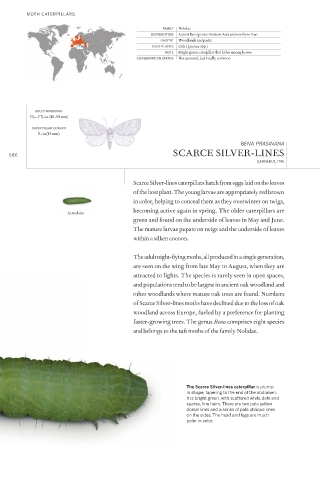
                                                             The Scarce Silver-lines caterpillar is plump
                                                             in shape, tapering to the end of the abdomen.
                                                             It is bright green, with scattered white dots and
                                                             sparse,   ne hairs. There are two pale yellow
                                                             dorsal lines and a series of pale oblique lines
                                                             on the sides. The head and legs are much
                                                             paler in color.

