


Page 586 - The Book of Caterpillars: A Life-Size Guide to Six Hundred Species From Around the World
P. 586
MOTH CATERPILLARS

                                                     FAMILY  Erebidae
                                                 DISTRIBUTION  North America, from Ontario to Nova Scotia, south to Florida,
                                                          and west to Texas
                                                    HABITAT  Barrens, pocosins, woodlands, and forests
                                                  HOST PLANTS  White and evergreen oak (Quercus spp.), blueberry (Vaccinium
                                                          spp.), and spruce (Picea spp.)
                                                      NOTE  Caterpillar that, if disturbed, hurls itself from the host plant
                                             CONSERVATION STATUS  Not evaluated, but uncommon


            ADULT WINGSPAN
           1⅜–1  ⁄   in (35–43 mm)


           CATERPILLAR LENGTH
             2 in (50 mm)
                                                                             ZALE AERUGINOSA
                                             GREEN-DUSTED ZALE MOTH
    584
                                                                                    (GUENÉE, 1852)


                                            Green-dusted Zale Moth caterpillars are very active in early
                                            instars and may wander some distance before feeding, usually on
                                            young leaves. In later instars, older leaves and spruce needles are
                                            consumed. The nontoxic plant diet of these caterpillars makes
                                            them prey for birds and other natural enemies. While they are
                                            cryptically colored and rest pressed against the host plant stem,
                                            when disturbed they may “jump” o  their perch, which o ers


                                            some additional protection against predators and parasitoids.
                                            The pupae overwinter in leaf litter. There are two generations
                                            a year in the south of the range but a single generation in the

                                            north. Adults  y from January to October.

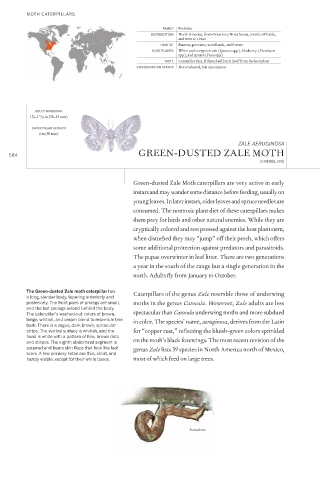
         The Green-dusted Zale moth caterpillar has   Caterpillars of the genus Zale resemble those of underwing
         a long, slender body, tapering anteriorly and
         posteriorly. The front pairs of prolegs are small,   moths in the genus Catocala. However, Zale adults are less
         and the last prolegs extend behind the body.
         The caterpillar’s washed-out colors of brown,   spectacular than Catocala underwing moths and more subdued
         beige, whitish, and cream blend to resemble tree   in color. The species’ name, aeruginosa, derives from the Latin
         bark. There is a vague, dark brown, spiracular

         stripe. The ventral surface is whitish, and the   for “copper rust,” re ecting the bluish-green colors sprinkled
         head is white with a pattern of   ne, brown dots   on the moth’s black forewings. The most recent revision of the
         and stripes. The eighth abdominal segment is
         squared and bears skin   aps that look like leaf   genus Zale lists 39 species in North America north of Mexico,
         scars. A few primary setae are thin, short, and
         hardly visible, except for their white bases.   most of which feed on large trees.


                                                             Actual size

