


Page 593 - The Book of Caterpillars: A Life-Size Guide to Six Hundred Species From Around the World
P. 593
MOTH CATERPILLARS

                      FAMILY  Noctuidae
                  DISTRIBUTION  Europe into central Asia, North Africa
                     HABITAT  Woodlands, gardens, and parks
                  HOST PLANTS  Trees, such as Sycamore (Acer pseudoplatanus), Horse Chestnut
                           (Aesculus hippocastanum), lime (Tilia spp.), poplar (Populus spp.),
                           and oak (Quercus spp.)
                      NOTE  Easily recognized caterpillar resembling a tuft from a
                           yellow carpet
             CONSERVATION STATUS  Not evaluated, but regionally endangered


                                                                                   ADULT WINGSPAN

                                                                                  1⅜–1¾ in (35–45 mm)

                                                                                  CATERPILLAR LENGTH
                                                                                    1 ⁄   in (40 mm)
            ACRONICTA ACERIS
            SYCAMORE                                                                             591

            LINNAEUS, 1758


            Caterpillars of the Sycamore moth hatch from checkered,
            black-and-white eggs. The young larvae are covered in long
            hairs, which are initially ginger but become more yellow with
            age. The dense tufts of hairs—a distinctive feature—can cause
            mild irritation, deterring would-be predators. Although brightly
            colored, the caterpillar is not poisonous. When disturbed, the
            caterpillar curls into a distinctive U shape.


            The pupae overwinter under bark, especially the bark of old
            poplar trees. There is a single generation each year, with the
            adult moths on the wing from late spring to midsummer. The
            Sycamore is under threat from the loss of its woodland habitat.
            In particular, the felling of old hybrid poplar trees that were once
            common along roads and on farmland has a ected numbers.

            The genus Acronicta contains around 150 species, most of which
            have conspicuous, brightly colored, hairy caterpillars.


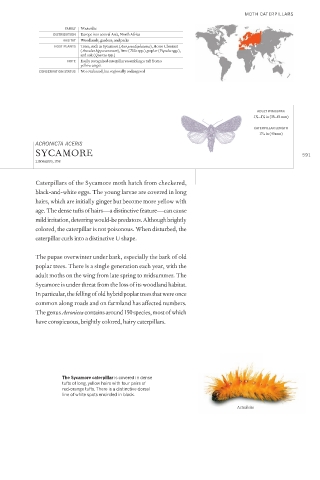
                     The Sycamore caterpillar is covered in dense
                     tufts of long, yellow hairs with four pairs of
                     red-orange tufts. There is a distinctive dorsal
                     line of white spots encircled in black.
                                                                             Actual size

