


Page 595 - The Book of Caterpillars: A Life-Size Guide to Six Hundred Species From Around the World
P. 595
MOTH CATERPILLARS

                      FAMILY  Noctuidae
                  DISTRIBUTION  Europe, excluding United Kingdom, into Asia, east to
                           western Siberia
                     HABITAT  Scrubby grasslands, clearings in woodlands, and dry forest fringes
                  HOST PLANTS  Various, including Heather (Calluna vulgaris), Rubus spp.,
                           oak (Quercus spp.), and Vaccinium spp.
                      NOTE  Black caterpillar that has tufts of brightly colored hairs
             CONSERVATION STATUS  Not evaluated, but locally rare


                                                                                   ADULT WINGSPAN
                                                                                  1 ⁄  –1⅝ in (36–42 mm)
                                                                                  CATERPILLAR LENGTH
                                                                                    1 ⁄   in (40 mm)
            ACRONICTA AURICOMA
            SCARCE DAGGER                                                                        593

            (DENNIS & SCHIFFERMÜLLER, 1775)


            The Scarce Dagger is a distinctive caterpillar that is seen in
            a wide range of wooded habitats over spring and summer,
            although populations are declining in many areas as a result of
            increased urbanization. There are two generations a year, with
            the adult moths on the wing from April to June and then again in
            July to August. The pupae of the second generation overwinter,
            either on the host plant or in the leaf litter below it.


            Like most caterpillars within the genus Acronicta, the Scarce
            Dagger has brightly colored hairs that deter predators. In some
            parts of its range, the caterpillar is considered a pest as it feeds on
            the leaves of economically valuable plants such as bilberries. The
            adult, a former resident but now rare immigrant in the United
            Kingdom, is one of a number of so-called “dagger moths”
            within Acronicta, named for the black, dagger-shaped markings
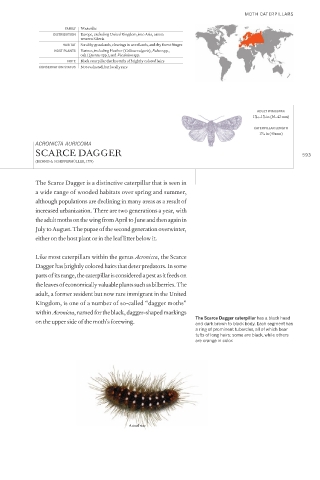
            on the upper side of the moth’s forewing.          The Scarce Dagger caterpillar has a black head
                                                               and dark brown to black body. Each segment has
                                                               a ring of prominent tubercles, all of which bear
                                                               tufts of long hairs; some are black, while others
                                                               are orange in color.


                                          Actual size

