


Page 596 - The Book of Caterpillars: A Life-Size Guide to Six Hundred Species From Around the World
P. 596
MOTH CATERPILLARS

                                                     FAMILY  Noctuidae
                                                 DISTRIBUTION  From Morocco and northern Spain through central and eastern
                                                          Europe (excluding the Mediterranean basin), Asia Minor, and the
                                                          Caucasus; southern Scandinavia east across Russia and southern
                                                          Siberia to China, Korea, Japan, and Russian Far East
                                                    HABITAT  Damp woodlands, marshes, bogs, and other damp habitats
                                                  HOST PLANTS  Alder (Alnus spp.) and birch (Betula spp.); also Rowan
                                                          (Sorbus aucuparia)
                                                      NOTE  Caterpillar of damp places that has a broad, yellow stripe
                                             CONSERVATION STATUS  Not evaluated, but local in western Europe due to habitat loss
                                                          from drainage


            ADULT WINGSPAN
             1  ⁄   in (43 mm)
           CATERPILLAR LENGTH
           1 ⁄  –1⅝ in (40–42 mm)
                                                                             ACRONICTA CUSPIS
                                                                  LARGE DAGGER
    594
                                                                                   (HÜBNER, [1813])


                                            Large Dagger caterpillars hatch from eggs laid singly on the
                                            underside of host plant leaves. The larvae feed openly on
                                            the leaves as they develop. In their final instar, when their
                                            distinctive yellow dorsal stripe fades to white, the caterpillars
                                            descend to pupate in a cocoon formed within rotten wood or
                                            under bark. There are one or two generations annually from
                                            June to October. The daggerlike markings on the forewings of
                                            adults give this and other Acronicta species their common name.


                                            At early instars, the Large Dagger and the Grey Dagger
                                            (Acronicta psi), which shares a similar geographic range, are
                                            quite difficult to tell apart. When more mature, both have
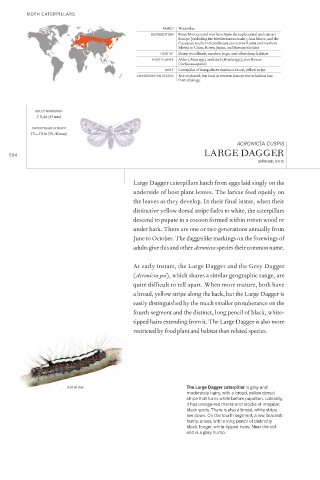
                                            a broad, yellow stripe along the back, but the Large Dagger is
                                            easily distinguished by the much smaller protuberance on the
                                            fourth segment and the distinct, long pencil of black, white-
                                            tipped hairs extending from it. The Large Dagger is also more
                                            restricted by food plant and habitat than related species.


                      Actual size                            The Large Dagger caterpillar is gray and
                                                             moderately hairy, with a broad, yellow dorsal
                                                             stripe that turns white before pupation. Laterally,
                                                             it has orange-red marks and blocks of irregular,
                                                             black spots. There is also a broad, white stripe
                                                             low down. On the fourth segment, a low, blackish
                                                             hump arises, with a long pencil of distinctly
                                                             black, longer, white-tipped hairs. Near the tail
                                                             end is a gray hump.

