


Page 597 - The Book of Caterpillars: A Life-Size Guide to Six Hundred Species From Around the World
P. 597
MOTH CATERPILLARS

                      FAMILY  Noctuidae
                  DISTRIBUTION  Europe, excluding the far north of Scandinavia; Asia Minor,
                           the Caucasus, Syria, northern Iran, and western Russia
                     HABITAT  Woodlands, hedgerows, and poplars growing in open country
                  HOST PLANTS  Poplar (Populus spp.), including Aspen (P. tremula) and
                           Black Poplar (P. nigra); occasionally willow (Salix spp.)
                      NOTE  Species named for the large head of its caterpillar
             CONSERVATION STATUS  Not evaluated


                                                                                   ADULT WINGSPAN
                                                                                  1½–1¾ in (38–44 mm)
                                                                                  CATERPILLAR LENGTH


                                                                                  1¼–1⅜ in (32–35 mm)
            ACRONICTA MEGACEPHALA
            POPLAR GREY                                                                          595
            ([DENIS & SCHIFFERMÜLLER], 1775)


            The Poplar Grey caterpillar hatches from a  attened, rounded,

            partly translucent egg laid singly on the leaves. It feeds openly
            on the leaves, resting on or under a leaf, with the front end curled
            around almost facing the tail end in a characteristic posture that
            resembles a bird dropping. The caterpillars can be found in one
            or two generations from June to September. The pupa is formed
            in a strong cocoon on the tree under loose bark, in a crevice or
            rotten wood, or in the ground, and this stage overwinters.


            With its large head and long, shaggy fringe of whitish hairs,
            the Poplar Grey caterpillar is unlikely to be confused with any

            other larva feeding on poplars and willows. The speci c name
            of the Poplar Grey, megacephala, is derived from the ancient
            Greek words megas, meaning “large” or “mighty,” and cephala,
            meaning “head.”


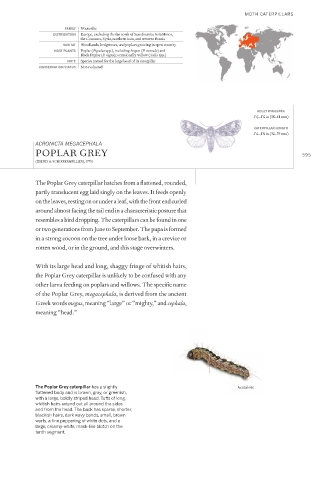
            The Poplar Grey caterpillar has a slightly                       Actual size
              attened body and is brown, gray, or greenish,
            with a large, boldly striped head. Tufts of long,
            whitish hairs extend out all around the sides
            and from the head. The back has sparse, shorter,
            blackish hairs, dark wavy bands, small, brown
            warts, a   ne peppering of white dots, and a
            large, creamy-white, mask-like blotch on the
            tenth segment.

