


Page 598 - The Book of Caterpillars: A Life-Size Guide to Six Hundred Species From Around the World
P. 598
MOTH CATERPILLARS

                                                     FAMILY  Noctuidae
                                                 DISTRIBUTION  Europe, including southern and eastern Scandinavia, east across
                                                          Russia and central Asia to Magadan, Mongolia, China, and Korea
                                                    HABITAT  Woodlands, scrub, and often parklands and gardens
                                                  HOST PLANTS  Wide variety of broadleaved trees and bushes, including willow
                                                          (Salix spp.), lime (Tilia spp.), oak (Quercus spp.), hawthorn
                                                          (Crataegus spp.), and rose (Rosa spp.)
                                                      NOTE  Hairy caterpillar that has a yellow dorsal stripe and hump
                                             CONSERVATION STATUS  Not evaluated


            ADULT WINGSPAN
           1 ⁄  –1¾ in (33–45 mm)
           CATERPILLAR LENGTH
           1 ⁄  –1 ⁄   in (36–40 mm)
                                                                                ACRONICTA PSI
                                                                    GREY DAGGER
    596
                                                                                   (LINNAEUS, 1758)


                                            The Grey Dagger caterpillar hatches from a domed, whitish
                                            egg laid singly on a leaf. It feeds and rests openly on the food
                                            plant, in one or two generations from June to October. When
                                            the larva is fully fed, the yellow stripe along its back turns white
                                            and it is then often seen descending the tree to seek out a cavity
                                            under loose bark, rotten wood, or the ground, in which it forms
                                            a glossy brown pupa in a tough cocoon. This stage overwinters,
                                            with adults eclosing the following summer.


                                            Few noctuid caterpillars are noticeably hairy, but the
                                            Acronictinae (dagger moths, named for the forewing markings)
                                            are an exception. The adult Grey Dagger and Dark Dagger
                                            (Acronicta tridens) are almost identical, but the caterpillars
                                            are easy to tell apart. The Dark Dagger has a much shorter
                                            protuberance on the fourth segment, and the dorsal stripe is

                                            orange-red and yellow (or white and yellow) with a  ne dark
                                            central line; it also has some white spots.


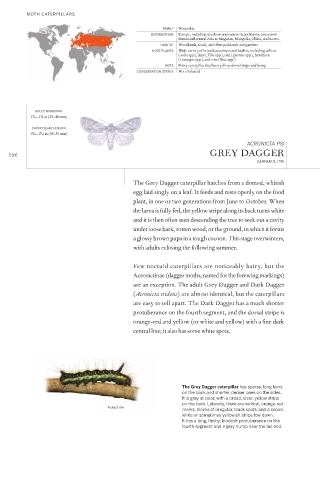
                                                           The Grey Dagger caterpillar has sparse, long hairs
                                                           on the back and shorter, denser ones on the sides.
                                                           It is gray in color, with a broad, clear, yellow stripe
                                                           on the back. Laterally, there are vertical, orange-red
                                   Actual size
                                                           marks, blocks of irregular, black spots, and a broad,
                                                           white or sometimes yellowish stripe low down.
                                                           It has a long,   eshy, blackish protuberance on the
                                                           fourth segment and a gray hump near the tail end.

