


Page 599 - The Book of Caterpillars: A Life-Size Guide to Six Hundred Species From Around the World
P. 599
MOTH CATERPILLARS

                      FAMILY  Noctuidae
                  DISTRIBUTION  From eastern Spain, western France, the British Isles, and
                           southern Scandinavia, east to western Turkey and western Russia
                     HABITAT  Wide variety, including woodlands, moorlands, marshes,
                           hedgerows, rough ground, and gardens
                  HOST PLANTS  Many herbaceous plants, including Common Sorrel (Rumex
                           acetosa), Meadowsweet (Filipendula ulmaria), and grasses
                           (Poaceae); also broadleaved trees, including willow (Salix spp.)
                           and hawthorn (Crataegus spp.)
                      NOTE  Caterpillar that lies dormant in its cocoon before pupating
             CONSERVATION STATUS  Not evaluated, but widespread


                                                                                   ADULT WINGSPAN
                                                                                  1 ⁄  –1 ⁄   in (30–40 mm)
                                                                                  CATERPILLAR LENGTH

                                                                                  1⅜–1 ⁄   in (35–40 mm)

            AGROCHOLA LITURA
            BROWN-SPOT PINION                                                                    597
            (LINNAEUS, 1761)


            Brown-spot Pinion caterpillars hatch from brownish eggs.
            These are laid in small batches, probably on dead vegetation,
            twigs, or bark, and they overwinter before the larvae hatch.
            At  rst the caterpillar consumes the foliage of herbaceous plants

            and grasses and, when larger, may ascend to feed on bushes and
            trees. A single, annual generation develops from April to June.
            When fully fed, the caterpillar forms a cocoon in the ground,
            in which it lies dormant for several weeks before pupating.

            The moths  y from late August to November.

            The Brown-spot Pinion caterpillar feeds mainly at night when
            larger and so is not often seen. It closely resembles the equally
            widespread Beaded Chestnut (Agrochola lychnidis), with similar
            color variation. In its brown form, the Brown-spot Pinion can
            be distinguished from the Beaded Chestnut by the blackish
            spot above and behind each spiracle (absent in the green form).
            The similar, brown-colored Flounced Chestnut (A. helvola)
            caterpillar has a bolder white stripe along the sides.


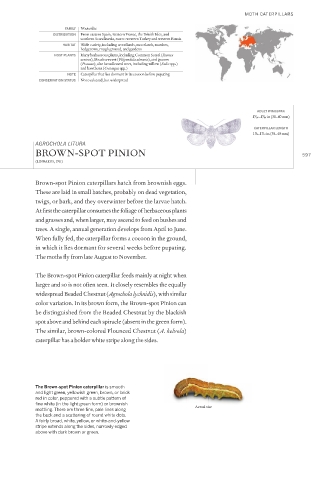
            The Brown-spot Pinion caterpillar is smooth
            and light green, yellowish green, brown, or brick
            red in color, peppered with a subtle pattern of
              ne white (in the light green form) or brownish   Actual size
            mottling. There are three   ne, pale lines along
            the back and a scattering of round white dots.
            A fairly broad, white, yellow, or white-and-yellow
            stripe extends along the sides, narrowly edged
            above with dark brown or green.

