


Page 600 - The Book of Caterpillars: A Life-Size Guide to Six Hundred Species From Around the World
P. 600
MOTH CATERPILLARS

                                                     FAMILY  Noctuidae
                                                 DISTRIBUTION  Western Europe, including Iberia and most of the British
                                                          Isles, and east through central and southern Europe to the
                                                          Balkans and Crimea
                                                    HABITAT  Wide variety, including grasslands, heathlands, woodland
                                                          farmlands, and gardens
                                                  HOST PLANTS  Various herbaceous plants, including dock (Rumex spp.),
                                                          Knot-grass (Polygonum aviculare), lettuce (Lactuca spp.),
                                                          and grasses (Poaceae)
                                                      NOTE  Small, brown cutworm caterpillar, but not a pest species
                                             CONSERVATION STATUS  Not evaluated


            ADULT WINGSPAN
           1 ⁄  –1¼ in (30–32 mm)
           CATERPILLAR LENGTH
           1 ⁄  –1 ⁄   in (30–33 mm)
                                                                                AGROTIS PUTA
                                                    SHUTTLE-SHAPED DART
    598
                                                                                   (HÜBNER, [1803])


                                            Shuttle-shaped Dart caterpillars hatch from brownish, globular
                                            eggs laid in batches on the food plant. They feed at night close to
                                            the ground and hide by day, often slightly beneath the surface.
                                            There are two or three generations, which may overlap so
                                            that, depending on climate, caterpillars are found from May
                                            throughout the summer and fall, usually overwintering fully
                                            grown in the ground, where the pupa is formed in March or
                                            April. The moths  y from April to June, July to August, and,

                                            in some places, in the fall, although in lesser numbers.


                                            The Agrotis puta caterpillar is typical of larvae of this genus,
                                            whose members are also known as cutworms because they eat
                                            through the bases of stems, mostly near the ground, and through
                                            roots. Some species, although not A. puta, are agricultural
                                            pests in di erent parts of the world. Agrotis larvae tend to look

                                            very similar to one another, and those of the closely related
                                            A. catalaunensis are almost indistinguishable from the Shuttle-
                                            shaped Dart, as are the adults. This has led to some uncertainty
                                            over the exact distribution of A. puta.


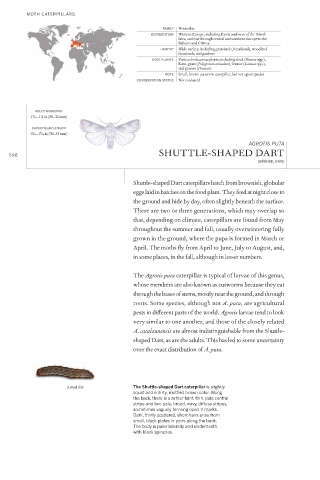
                      Actual size           The Shuttle-shaped Dart caterpillar is slightly
                                            squat and a dirty, mottled brown color. Along
                                            the back, there is a rather faint, thin, pale central
                                            stripe and two pale, broad, wavy, di  use stripes,
                                            sometimes vaguely forming open V marks.
                                            Dark, thinly scattered, short hairs arise from
                                            small, black plates in pairs along the back.
                                            The body is paler laterally and underneath,
                                            with black spiracles.

