


Page 601 - The Book of Caterpillars: A Life-Size Guide to Six Hundred Species From Around the World
P. 601
MOTH CATERPILLARS

                      FAMILY  Noctuidae
                  DISTRIBUTION  Europe, from east of the Pyrenees and northern Italy, the
                           British Isles, and southern Scandinavia, east to the southern Urals,
                           the Caspian Sea, and western Russia
                     HABITAT  Woodlands, moorlands, heathlands, scrub, hedgerows, parklands,
                           and gardens
                  HOST PLANTS  Hawthorn (Crataegus spp.), Blackthorn (Prunus spinosa),
                           plum (Prunus spp.), apple (Malus spp.), and, in northern
                           British Isles, Rowan (Sorbus aucuparia)
                      NOTE  Twiggy caterpillar found on plants in the rose family
             CONSERVATION STATUS  Not evaluated


                                                                                   ADULT WINGSPAN


                                                                                  1⅜–2 in (35–50 mm)
                                                                                  CATERPILLAR LENGTH
                                                                                  1¾–2 in (45–50 mm)
            ALLOPHYES OXYACANTHAE
            GREEN-BRINDLED CRESCENT                                                              599

            (LINNAEUS, 1758)


            The Green-brindled Crescent caterpillar hatches from a ribbed,
            whitish egg laid on a twig or branch; the eggs overwinter. The
            caterpillar feeds from April to June, resting along a twig, well

            camou aged by its twiglike appearance. When fully fed, it forms
            a glossy brown pupa in a strong cocoon in the ground. The
            adults emerge in the fall, in one annual generation. Allophyes
            oxyacanthae is one of several species that look very similar to
            one another in all life stages. The others, A. cretica, A. asiatica,
            A. alfaroi, and A. corsica, are restricted to warm, dry, scrubby
            habitats around the Mediterranean, whereas A. oxyacanthae
            occurs more widely and in cooler, damper climates.


            The caterpillar of the closely related Double-spot Brocade
            (Meganephria bimaculosa) is similar but much browner. The
            Green-brindled Crescent caterpillar also bears a general
            resemblance to certain Catocala species (Erebidae), although
            they have a side-fringe of hairs, mostly grow larger, and rarely
            feed on plants of the Rosaceae family.


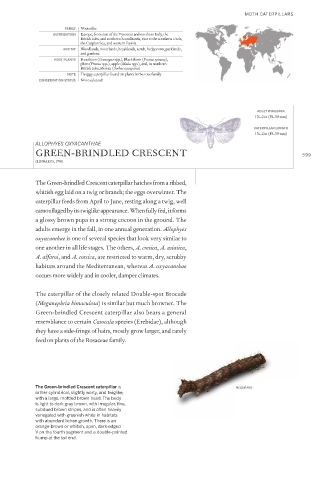
            The Green-brindled Crescent caterpillar is                      Actual size
            rather cylindrical, slightly warty, and twiglike,
            with a large, mottled brown head. The body
            is light to dark gray brown, with irregular,   ne,
            subdued brown stripes, and is often heavily
            variegated with greenish white in habitats
            with abundant lichen growth. There is an
            orange-brown or whitish, open, dark-edged
            V on the fourth segment and a double-pointed
            hump at the tail end.

