


Page 602 - The Book of Caterpillars: A Life-Size Guide to Six Hundred Species From Around the World
P. 602
MOTH CATERPILLARS

                                                     FAMILY  Noctuidae
                                                 DISTRIBUTION  United States, southern Canada, North Africa, Europe, the
                                                          Middle East, northern India, Russia, Mongolia, northern China,
                                                          Korea, and Japan
                                                    HABITAT  Deciduous woodlands, parks, and gardens
                                                  HOST PLANTS  Deciduous trees and shrubs, especially oak (Quercus spp.)
                                                      NOTE  Green caterpillar that has a pyramid-shaped dorsal hump
                                             CONSERVATION STATUS  Not evaluated, but a relatively common species


            ADULT WINGSPAN
           1 ⁄  –2 ⁄   in (40–52 mm)
           CATERPILLAR LENGTH

           1⅜–1⅝ in (35–42 mm)

                                                                         AMPHIPYRA PYRAMIDEA
                                                        COPPER UNDERWING
    600
                                                                                   (LINNAEUS, 1758)


                                            The Copper Underwing female moth lays her eggs, singly or
                                            in small groups, on the bark of host trees or shrubs. The eggs
                                            overwinter and hatch in spring, the caterpillars appearing as
                                            early as April and as late as June. The larvae feed on leaves of
                                            the host plant and then pupate inside a leaf shelter, which they
                                            build by rolling a leaf and securing it with threads of silk.


                                            There is a single generation, with the night- ying adults on the
                                            wing from August to October. The species name of the Copper
                                            Underwing comes from the pyramid-shaped hump at the end
                                            of the caterpillar’s abdomen, and this feature is reflected in
                                            some of the moth’s alternative names, such as the Pyramidal
                                            Green Fruitworm and the Humped Green Fruitworm.
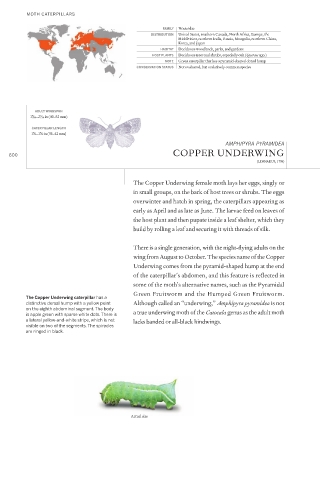
         The Copper Underwing caterpillar has a
         distinctive dorsal hump with a yellow point   Although called an “underwing,” Amphipyra pyramidea is not
         on the eighth abdominal segment. The body   a true underwing moth of the Catocala genus as the adult moth
         is apple green with sparse white dots. There is
         a lateral yellow-and-white stripe, which is not   lacks banded or all-black hindwings.
         visible on two of the segments. The spiracles
         are ringed in black.


                                           Actual size

