


Page 603 - The Book of Caterpillars: A Life-Size Guide to Six Hundred Species From Around the World
P. 603
MOTH CATERPILLARS

                      FAMILY  Noctuidae
                  DISTRIBUTION  Europe, excluding northernmost Scandinavia; Asia Minor,
                           the Middle East, western central Asia east to China (Xinjiang),
                           and southern Siberia to Lake Baikal; Sakhalin Island (Russian
                           Far East)

                     HABITAT  Grasslands, from gardens to arable  elds, wastelands, woodland
                           rides, coastal dunes, and high moorlands; mainly at higher
                           altitudes in warmer climates
                  HOST PLANTS  Grasses, including Cock’s-foot (Dactylis glomerata), fescue
                           (Festuca spp.), reed-grass (Calamagrostis spp.), and hair-grass
                           (Deschampsia spp.)
                      NOTE  Caterpillar that lives in a chamber in grass tussocks
             CONSERVATION STATUS  Not evaluated, but widespread and common


                                                                                   ADULT WINGSPAN
                                                                                  1¾–2⅛ in (45–55 mm)
                                                                                  CATERPILLAR LENGTH
                                                                                  1 ⁄  –2⅛ in (40–45 mm)
            APAMEA MONOGLYPHA
            DARK ARCHES                                                                          601

            (HUFNAGEL, 1766)


            The Dark Arches caterpillar hatches from an oval, whitish egg
            laid in small groups on a grass leaf sheath or seed head that

            provides its  rst meal. The larva soon descends the plant to live
            in a silken chamber among the roots and lower stems, which it
            feeds on until it is full grown. There is one main generation;
            the caterpillars overwinter, feeding in mild weather, then
            leave the chamber in April or May to form a pupa in the
            ground. The main adult flight is from June to August, with
            small numbers of a second generation in the fall.


            Although it is an abundant species throughout its range and in
            many habitats, the Dark Arches caterpillar, unless it is disturbed
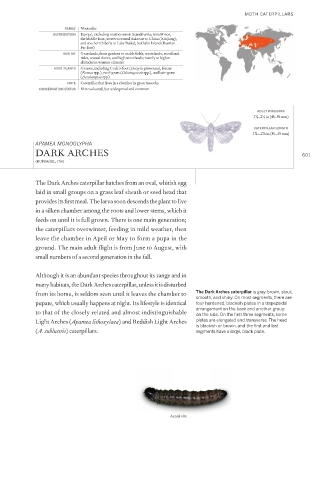
            from its home, is seldom seen until it leaves the chamber to   The Dark Arches caterpillar is gray brown, stout,
                                                                smooth, and shiny. On most segments, there are
            pupate, which usually happens at night. Its lifestyle is identical   four hardened, blackish plates in a trapezoidal
            to that of the closely related and almost indistinguishable   arrangement on the back and another group
                                                                on the side. On the   rst three segments, some
            Light Arches (Apamea lithoxylaea) and Reddish Light Arches   plates are elongated and transverse. The head
            (A. sublustris) caterpillars.                       is blackish or brown, and the   rst and last
                                                                segments have a large, black plate.


                                                       Actual size

