


Page 604 - The Book of Caterpillars: A Life-Size Guide to Six Hundred Species From Around the World
P. 604
MOTH CATERPILLARS

                                                     FAMILY  Noctuidae
                                                 DISTRIBUTION  India, Southeast Asia, Japan, Fiji, New Guinea, and Norfolk
                                                          Island (Australia)
                                                    HABITAT  Woodlands, forests, and urban areas
                                                  HOST PLANTS  China Ramie (Boehmeria nipononivea) and Boehmeria australis
                                                      NOTE  Aposematic caterpillar that produces a fruit-piercing moth
                                             CONSERVATION STATUS  Not evaluated, but locally common


            ADULT WINGSPAN
           3⅜–3½ in (85–90 mm)
           CATERPILLAR LENGTH
           2⅜–2 ⁄   in (60–65 mm)
                                                                              ARCTE COERULEA
                                                                      RAMIE MOTH
    602
                                                                                     GUENÉE, 1852


                                            Ramie Moth caterpillars hatch and then feed primarily on
                                            canopy shoots of the host plant; development on these shoots
                                            is better than on understory shoots. The larvae are able to
                                            withstand the chemical defenses of the host plant and likely store
                                            the poisons they ingest, making them unpalatable to vertebrate
                                            predators. This is advertised by the aposematic coloration of
                                            the caterpillars. They develop through six instars and pupate in
                                            a slight, silken cocoon between leaves drawn together with silk.


                                            Two to three generations of caterpillars of this species
                                            appear during spring to fall, with large outbreaks sometimes
                                            occurring from August to September, causing severe damage

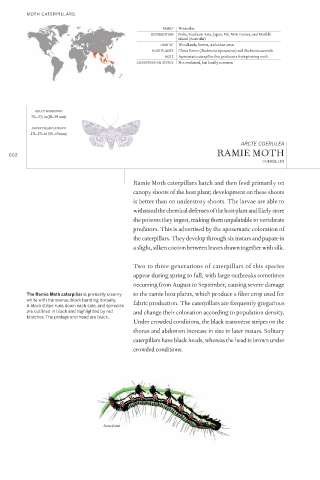
          The Ramie Moth caterpillar is primarily creamy   to the ramie host plants, which produce a  ber crop used for
          white with transverse, black banding dorsally.   fabric production. The caterpillars are frequently gregarious
          A black stripe runs down each side, and spiracles
          are outlined in black and highlighted by red   and change their coloration according to population density.
          blotches. The prolegs and head are black.
                                            Under crowded conditions, the black transverse stripes on the
                                            thorax and abdomen increase in size in later instars. Solitary
                                            caterpillars have black heads, whereas the head is brown under
                                            crowded conditions.


                                  Actual size

