


Page 609 - The Book of Caterpillars: A Life-Size Guide to Six Hundred Species From Around the World
P. 609
MOTH CATERPILLARS

                      FAMILY  Noctuidae
                  DISTRIBUTION  Canada and United States
                     HABITAT  Deciduous forests
                  HOST PLANTS  Mainly beech (Fagus spp.), but also other trees, including birch
                           (Betula spp.), maple (Acer spp.), and oak (Quercus spp.)
                      NOTE  Hairy caterpillar with distinctive yellow markings on its
                           black head
             CONSERVATION STATUS  Not evaluated


                                                                                   ADULT WINGSPAN
                                                                                  1½–1⅞ in (38–48 mm)
                                                                                  CATERPILLAR LENGTH
                                                                                  1 ⁄  –1 ⁄   in (30–40 mm)
            CHARADRA DERIDENS
            LAUGHER                                                                              607

            (GUENÉE, 1852)


            The Laugher caterpillar is characterized by a large, boldly
            marked head possibly designed to startle birds that attack
            its leaf shelters. The larvae feed on the leaves of a variety of
            broad-leaved trees, in particular beech, and can cope with tough,
            older leaves that are often avoided by other species of caterpillar.
            They gain protection by spinning a silken nest between a couple
            of leaves, in which they rest, or sometimes they will use the
            shelters of other caterpillars.


            The caterpillar spins a light cocoon on the food plant, in which
            it overwinters and pupates the following spring. There are two
            generations a year. In the northern part of the range, the moths
            are on the wing from May to August, but farther south they
            have a much longer season. Also called the Marbled Tu et, this

            species is a type of owlet moth. It gets the name Laugher from
            the pattern of markings on the moth’s forewing, which resembles
            a laughing face.


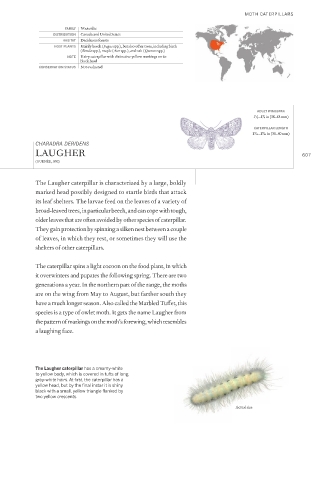
            The Laugher caterpillar has a creamy-white
            to yellow body, which is covered in tufts of long,
            gray-white hairs. At   rst, the caterpillar has a
            yellow head, but by the   nal instar it is shiny
            black with a small, yellow triangle   anked by
            two yellow crescents.
                                                                            Actual size

