


Page 605 - The Book of Caterpillars: A Life-Size Guide to Six Hundred Species From Around the World
P. 605
MOTH CATERPILLARS

                      FAMILY  Noctuidae
                  DISTRIBUTION  Mediterranean Europe, throughout Africa and the Middle East,
                           South and Southeast Asia, Japan, and northern Australia
                     HABITAT  Coastal sand dunes
                  HOST PLANTS  Lilies, including Amaryllis spp., Crinum spp., Narcissus spp.,
                           and Pancratium maritimum
                      NOTE  Black-and-white caterpillar that feeds on lily plants
             CONSERVATION STATUS  Not evaluated, but endangered in Europe


                                                                                   ADULT WINGSPAN
                                                                                    1 ⁄   in (40 mm)
                                                                                  CATERPILLAR LENGTH
                                                                                  1 ⁄  –2 in (40–50 mm)
            BRITHYS CRINI
            LILY BORER                                                                           603

            FABRICIUS, 1775


            The caterpillars of the Lily Borer moth, also known as Kew
            Arches, hatch from pale yellow eggs laid in small clusters on
            the leaf of a host plant. Initially, the young caterpillars mine

            into the  eshy leaves where they feed, but later they emerge
            to feed externally, moving down the leaves toward the bulb.
            The bright colors of the larvae warn predators that they are
            unpalatable, the poisons coming from the leaves of the host
            plants. To pupate, the caterpillars move to the ground, just under
            the surface in sandy soil.


            The adult moth is on the wing from March through September,
            and there are two, possibly three, generations each year, with

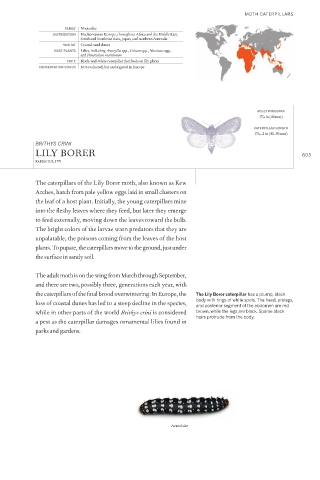
            the caterpillars of the  nal brood overwintering. In Europe, the   The Lily Borer caterpillar has a plump, black
            loss of coastal dunes has led to a steep decline in the species,   body with rings of white spots. The head, prolegs,
                                                                and posterior segment of the abdomen are red
            while in other parts of the world Brithys crini is considered   brown, while the legs are black. Sparse black
            a pest as the caterpillar damages ornamental lilies found in   hairs protrude from the body.
            parks and gardens.


                                                        Actual size

