


Page 607 - The Book of Caterpillars: A Life-Size Guide to Six Hundred Species From Around the World
P. 607
MOTH CATERPILLARS

                      FAMILY  Noctuidae
                  DISTRIBUTION  From northern Spain through most of Europe (excluding extreme
                           south), north to Iceland and Scandinavia, and across Russia and
                           Siberia to Russian Far East
                     HABITAT  Cool, open habitats, such as high moorlands and mature coastal
                           dunes; lesser numbers in warmer, open, scrubby habitats
                  HOST PLANTS  Wide range, including Heather (Calluna vulgaris), Broom
                           (Cytisus scoparius), Bracken (Pteridium aquilinum), Bramble
                           (Rubus fruticosus), willow (Salix spp.), Sea Buckthorn
                           (Hippophae rhamnoides), and Colt’s-foot (Tussilago farfara)
                      NOTE  Pretty, striped caterpillar that is easily found in the daytime
             CONSERVATION STATUS  Not evaluated


                                                                                   ADULT WINGSPAN
                                                                                  1¼–1⅝ in (32–42 mm)
                                                                                  CATERPILLAR LENGTH
                                                                                  1 ⁄  –1¾ in (40–45 mm)
            CERAMICA PISI
            BROOM MOTH                                                                           605

            (LINNAEUS, 1758)


            Broom Moth caterpillars hatch from yellowish-gray eggs laid in
            batches on the food plant. The larvae are inconspicuous when
            small but when larger are often seen resting or feeding openly

            by day, although they are more active at night. At the  nal instar,
            they form a pupa in a fragile cocoon in the ground, and the pupa
            overwinters. The caterpillars can be found from July into the

            fall; just one generation is produced annually. The adults  y
            from June to August.


            The Broom Moth caterpillar can occur in almost any scrubby,
            relatively undisturbed habitat. It is tolerant of cold and is most
            abundant in northern areas, particularly on acid moorland,
            whereas it may be uncommon in lowland gardens. With its set
            of four bright yellow stripes, the Ceramica pisi larva is quite
            distinctive and can be confused with few other caterpillars.
            Middle instars of the Sword-grass caterpillar (Xylena exsoleta)
            are also green with yellow stripes, but their stripes are narrower,
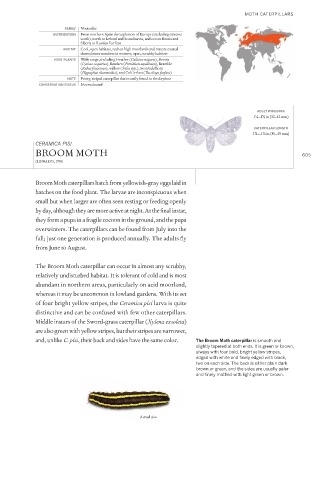
            and, unlike C. pisi, their back and sides have the same color.   The Broom Moth caterpillar is smooth and
                                                                slightly tapered at both ends. It is green or brown,
                                                                always with four bold, bright yellow stripes,
                                                                edged with white and   nely edged with black,
                                                                two on each side. The back is either plain dark
                                                                brown or green, and the sides are usually paler
                                                                and   nely mottled with light green or brown.


                                              Actual size

